And today Wrestle(videogame)mania reaches its conclusion. The following are lists of the Top Five WWF/WWE Videogame and the Top Five Non-WWE Videogames. Both lists are chronological. The lists are limited to one game from any given series.
Top Five WWF/WWE Videogames
-WWF Wrestlefest (1991, Technos, Coin-op) A true classic, the first WWF game with four player support, it's fast paced arcade play and huge sprites make it still a favorite of wrestling gamers today. Shame it never got a console port.
-WWF Wrestlemania: The Arcade Game (1995, Midway, Coin-op) It's NBA Jam, but with wrestling! What more could you ask for? I still pop in the Playstation port once in a while, simply because there's never really been another game like it. Well, there was a crappy pseudo-sequel from Acclaim for consoles, but it's worse in every way.
-WWF No Mercy (2000, THQ/AKI, Nintendo 64) Coming out just a week before the next entry on the list, this game is still my favorite wrestling game of all time. The single player (two player, if you're rocking a tag team) season mode has many unique stories with branching paths for each title (including the Women's Championship). All that coupled with a flawless grappling system make it the best out there.
-WWE Day of Reckoning 2 (2005, THQ/Yuke's, Gamecube) In a game that easily surpassed that year's Smackdown entry, Yuke's really outdid themselves with a long and well told story mode. The grappling system is among the best out there, allowing for reversals of finishing moves in the right situations. The best wrestling game you can put in your Wii, despite being a GC title.
-WWE Smackdown vs. Raw 2007 (2006, THQ/Yuke's, Playstation 2/Xbox 360) Many point to Smackdown: Here Comes the Pain as the best in the series, but this is the game that really does it for me. It introduced an analog stick-based grapple system that allowed for great customization of created wrestlers, and also allowed weight class to play heavily (e.g. Light Heavyweight Shawn Michaels cannot slam Super Heavyweight Big Show) and had plenty of season mode storylines to go around for your superstar, depending on which show you were on. A real winner, and both common and cheap nowadays. (Disclosure: I have not yet played SvR2010, though I've heard great things.)
Top Five Non-WWE Wrestling Videogames
-Pro Wrestling (1987, Nintendo R&D3, Nintendo Entertainment System) Maybe it's the nostalgia talking, but this game is still great. The characters are well developed, the movesets are huge for the time, they actually put a ref in the ring... it's got everything. Though a turbo controller is highly recommended for maximum enjoyment.
-Three Count Bout (1993, SNK, Neo-Geo) In general, I'd say avoid this game if you see it in an MVS. However, if you can adjust the difficulty down just a bit, this game is great. Huge sprites, totally different movesets for each wrestler, different match types (street fights, electrified rope death matches, etc.) all make this a classic. Of course, I do mark out for SNK, so maybe I'm a little biased.
-All-Japan Pro Wrestling: Giant Gram 2000 (2000, Sega, Dreamcast) An arcade game at heart, this game's unique grappling system that relies on timing-based combos to unleash hard-hitting moves is a must for any wrestling fan with a DC. I only recently was able to check this one out, and I'm hooked!
-King of Colosseum II (2004, Spike, Playstation 2) This game is the best non-WWE 3D wrestling game. It contains a grappling system so deep, it's near impossible to explain here, but suffice it to explain that the time you spend learning it is time well spent. It also is officially licensed by all of Japan's big promotions, which allows for the kind of dream matches not seen in US wrestling games.
-Fire Pro Wrestling Returns (2007, Agetec/Spike, Playstation 2) This game is the end-all, be-all of wrestling games. Only overshadowed by No Mercy for it's extensive single player mode, Fire Pro Returns' gameplay, grappling system, and near endless customization options make this game THE wrestling game to beat. It's ten bucks, brand new, from Amazon right now. If you have a PS2 and even a passing interest in wresting games, it's money well spent.
Tomorrow: Wrestlemania Preview
Showing posts with label WWF. Show all posts
Showing posts with label WWF. Show all posts
Friday, March 26, 2010

Thursday, March 25, 2010
Wrestle(videogame)mania Week, Part the Second: A Brief History of Non-WWE Wrestling Videogames
When people think pro wrestling, they automatically think WWF/WWE. Some, who were fans of the second renaissance of pro wrestling (the late 1990s) might think WCW as well, but even most casual fans from that time period are aware that the Monday Night Wars ended with WCW being bought by Vince McMahon, lock, stock and barrel. That fact leads many to think of the post from Monday would be a reasonably comprehensive tour of the history of pro wrestling videogames, with only a couple NES games with fictional casts and some crappy WCW games that EA did as all that's left for this post.
Not so. No, if I let it, this post would be at least twice as long as Monday's. Fortunately, it's not going to be that. It's a basic primer for those with a fledgling interest in wrestling games who don't know the world beyond Smackdown vs. Raw and No Mercy. It's also a general purpose article for those with an interest in videogame history. There will be copious links provided at the end for those who wish to know more. That being said, let's get started with what you might already know.
Fictional Wrestlers
A very good place to start, as they were the first pro wrestling videogames. In fact, a couple of the early ones were just called Pro Wrestling. The best known of these is the NES game, developed by Nintendo R&D3 (the folks behind Punch-Out!! and StarTropics, to name a few). It gives each grappler a punch, a kick, a few standard grapples (body slam, belly-to-back suplex) and some unique moves. Interestingly, every wrestler can toss his opponent from the ring and execute a tope on their prone foe. This is, I'm fairly certain, the first videogame tope, and it wasn't something seen again for awhile.
The cast sets a good precedent that fictional grapplers would follow for, well, ever, really, in creating a cast that are fairly thinly veiled analogues of real pro wrestlers. Fighter Hayabusa is New Japan Pro Wrestling boss and star Antonio Inoki, Starman is the first major lucha libre (Mexican wrestling) star Mil Mascaras, Giant Panther is Hulk Hogan, Kin Corn Karn is Japanese/Korean star Rikidozan, The Amazon is equal parts Abdullah the Butcher and Bruiser Brody, King Slender is "The Nature Boy" Ric Flair and the final, unplayable boss Great Puma is Japan's iconic Tiger Mask. The game is still surpisingly solid today, but also was one of the early wrestling titles to use the "grapple, then mash buttons to see who gets to do their move" system that plagued so many wrestling games through the 16-bit era. A turbo controller is highly recommended for enjoyment now.


Tell me you don't see the resemblance.
There was also a Master System game of the same name, that seems to hew very closely to Namco's Tag Team Wrestling, which, aside from providing the source material for Homestarrunner.com's Strong Bad, is entirely forgettable. Other early games include Title Match Pro Wrestling for the Atari 2600 and 7800, as well as the Intellivision game Body Slam: Super Pro Wrestling. I've honestly never played the Atari game, and the Intellivision one is... not good.
Later, on the NES, we would see Tecmo World Wrestling, which isn't horrible, but half of the screen is taken up by a guy providing color commentary in text boxes. The highlight of that particular game are the close up, semi-cut scene style showings of big moves. The gameplay stops, zooms in, and you see your wrestler drop his finisher on your opponent, up close. Or you see yourself get pummeled up close, either way. This game also features caricatures of real wrestlers.
One NES game I have a soft spot for for no real discernable reason is M.U.S.C.L.E. Honestly, I understand the game is just completely awful, but I like it anyways. I think it's because I was obsessed with the little figures when I was a kid. M.U.S.C.L.E., if you were unawares, was actually based on a Shonen Jump manga called Kinnikuman, which follows the adventures of a bunch of super crazy powered space wrestlers... or something. Hell, I don't know. I just know the figures were sweet when I was little and the games got much better in the PS2/Gamecube era when AKI (makers of WWF No Mercy) took over development. Those games were based on the cartoon from the early 2000s which followed the exploits of Kinnikuman's son. It was localized here as "Ultimate Muscle," and aired on Fox Kids. The games used a system very similar to No Mercy, but with more superpowered slams and various rings. The best of the series released here is Galactic Wrestling featuring Ultimate Muscle.

The 16-bit era eased up on the fiction a bit, but we still saw Hammerlock Pro Wrestling and Natsume Championship Wrestling, both on SNES. These were both actual Japanese puroresu games that were localized to feature fictional wrestlers. The former was based on Genichiro Tenryu's Pro Wrestling Revolution: Wrestle & Romance, the latter on All-Japan Pro Wrestling. They're both middling at best, and if we were going to get ports of Japanese wrestling games, there are other SNES ones I'd've much rather had, but we'll get more into that later.
Capcom also was nice enough to bring us a few fictional grapplers, but only one got a console port. I'm sure many fondly remember Saturday Night Slammasters, both for Genesis and the SNES. It was ported from the arcade, and, even though it falls back a little on button mash-y grapples, it also included crazy special moves, and a glimpse at future Metro City mayor Mike Haggar's wrestling career, as he is one of the selectable characters. Capcom is also less bad about blatantly copying real wrestlers. While it's obvious that King Rasta is Bruiser Brody and Great Oni is Great Muta, the rest are pretty hard to pin down. Jumbo Flapjack could be John "Earthquake" Tenta, but he could also be Abdullah the Butcher. In a neat crossover, Biff Slamkovich references Zangief in his winning quote.

The console versions are pretty similar, but the Genesis version includes a death match option that surrounds the ring in barbed wire or electric ropes. The SNES version looks closest to the arcade and had four player support with the multitap. There was an arcade only pseudo-sequel called Muscle Bomber Duo that improved on the first game, but removed the option for 1-on-1 matches, it's basically Saturday Night Slammasters: Championship Edition. There was then a full-fledged sequel, but it had limited US release (I've never played it), and apparently is a traditional 2D fighter with wrestling ring backgrounds.
Of course, in the '90s, anything Capcom could do, SNK was bound and determined to attempt to do better, so they dropped 3 Count Bout on the Neo-Geo. A fully fictionalized roster with many transparent stand-ins (Terry Rogers is obviously Hulk Hogan with hair, even more obviously when you know Hulk's real name is Terry), but a really oddly great single player that involves death matches and even a parking lot brawl that allows you to grab a backstage interviewer and throw him at your opponent. Unfortunately, the oppressive difficulty, which stems from horrid button mashing that begins to always go in the CPU's favor after about two matches, makes the game pretty unfun, unless you're playing the AVS version and can scale the difficulty down.

The last grappler I remember being released with a fully fictional roster is Power Move Pro Wrestling from Activision for the PS1. It was also the first 3D wrestling game that came to the US. Power Move is actually a rejiggered version of the first New Japan game (Toukon Retsuden) for PS1, basically getting the same treatment as Natsume Championship Wrestling. It's basically WWF Smackdown 0, as it was developed by Yuke's and uses a really primative version of the same engine. It's only interesting as a curio now, as each guy only has about four grapples, there's no single player to speak of, and there's literally no match options besides 1-on-1. The instruction book is kind of neat, though, as they went to the trouble to flesh out all of the fictional grapplers' stories and rivalries.
WCW
I'm gonna be 100% honest with you here, dear reader. WCW's videogame output was about as good as their product, which is to say, it had some high points between 1997 and 1999, but other than that, it was garbage. The first WCW games were developed by Pony Canyon/FCI, and the first one, WCW Wrestling for NES, wasn't even a WCW game when it was developed. It was actually a game called Super Star Pro Wrestling that featured a variety of actual puroresu stars from various Japanese promotions.
The localization is so horrifically bad that even though the Road Warriors (a.k.a. Legion of Doom) are in both games, the version of Hawk in WCW Wrestling is actually Stan Hansen in Super Star Pro Wrestling, while the SSPW version of Hawk somehow became Michael "P.S." Hayes in the American game. The game is overly hard, uses that same button mash-y style and the wrestler's signature moves rarely line up with what their actual finishers were.

The second Pony Canyon WCW game was years later for the SNES and was called WCW Superbrawl Wrestling. It was actually developed by Beam Software, who gave us Back to the Future II & III for NES. You can imagine what it might be like. The game, quite frankly, is inscrutable. The HUD is crowded and sloppy and the controls are awful. It makes Acclaim's WWF efforts look like Super Mario Bros. 3. It's embarrassing. It should be avoided.

Superbrawl Wrestling's horrific character select screen. Yes, that is Johnny B. Badd you see there.
There were Gameboy games from Pony Canyon, too, but I've never played them. Based on what I know about the console WCW games and wrestling games on the black & white Gameboy, I think I'm better off.
They got better after that for two games, while AKI was handling their N64 output, and I would say that WCW/nWo Revenge is the best wrestling game to not feature a character creation tool. The only problem with these games now is that they are surpassed in every way by the WWF games that AKI made for the N64. I'm also told that AKI's Japan-only follow up, Virtual Pro Wrestling 2 shames these early efforts.
THQ also had some PS1 games (later ported to N64 and PC) developed, but not by AKI or by Yuke's, who would handle their WWE games once they took over that license. The games in question are WCW vs. the World, WCW Nitro and WCW Thunder. I bought Nitro the day it came out, and the friendly guy at Funcoland tried hard to dissuade me. I would not be dissuaded. I can only wish now that I had listened to him.

Developed by Inland Productions, the games both feature horrid graphics, no single player to speak of, an obnoxiously limited move set, and should just generally be avoided. The only redeeming factor are promos you can watch on the character select screen. Seriously, that is the only interesting thing about these games.
WCW vs. the World actually came before those, and was developed by AKI. It plays similarly to their N64 titles, but has fewer moves for each wrestler. Largely forgettable today.
After THQ lost the WCW license, EA won the bid. This is not the EA we know today that released things like Rock Band, Mirror's Edge and Left 4 Dead. No, this was the old, bad EA. This is an EA that released a myriad of awful WCW games, including one that was a wrestling game without a ring. I'll say that again; they released a wrestling game that HAD NO RING.

Who needs a ring when you can have a Jeff Jarrett mirror match?
I talked Monday about how bad Wrestlemania XIX for Gamecube was, but at least under all the stupid crap there was a point at which you wrestled. In a wrestling ring. EA, though, they released WCW Backstage Assault. What's the demographic for that, exactly? People surveyed revealed that their favorite part of wrestling programs were the muggings guys gave each other in the backstage areas? Are you joking?
Sadly, faithful readers, they were not. The predecessor, WCW Mayhem had a ring, and was pretty much just as awful. The system was just sloppy. It was a quick cash-in from the old EA. Apparently, they were starting to get it, and handed development of WCW Mayhem 2 to AKI, but, as we know, WWF bought WCW in 2001 and that game never reached shelves. EA would take AKI's beginnings of that game and create Def Jam Vendetta, more on that later.
ECW
ECW was only a strong enough promotion to have two videogames made. Both were done by Acclaim and they were continuations of the WWF Warzone series. It was nice at the time to see Rob Van Dam, Justin Credible and the ECW crew in game format, but the games themselves were derivative, offering little over what WWF Attitude had already offered.

The first game was for PS1, Dreamcast, N64 and Gameboy Color. I've never played the GBC games, but the other versions are entirely skippable in favor of Anarchy Rulz for PS1 and Dreamcast, which, honestly, is also not really worth a lot of your time unless you have some serious ECW nostalgia. Smackdown vs. Raw included ECW in their rosters for the last three years, but there was nothing inherently ECW-esque about the brand in any of those games.
Puroresu
Puroresu games often come to the US with fake casts, as we've discussed. Others just stay in Japan. Most of them we've kind of touched on by this point, but there are two that I want to touch on in particular. The first is a series that was actually done by a first party. Sega produced three All Japan Pro Wrestling games, one for Saturn/arcade, two for Dreamcast. None of them made it out of Japan, which is a shame because they're very, very good.
The first is called All Japan Pro Wrestling featuring Virtua, because it (like the others) featured a couple of characters from Virtua Fighter. It set the tone, but all the games basically build off of the same system and only get better. Giant Gram 2000 for Dreamcast is generally considered the best of the bunch. What makes the games great is the system. It's very basic, using a rock-paper-scissors system which means throws beat grapples, grapples beat attacks, and attacks beat throws.

The thing that makes the game really unique, though, is the combo system. For example, if you are using a character that has a verical suplex, doing a button imput (often down and B) at just the right time turns it into a brainbuster. The reversal system works on a similar principle. Unlike Smackdown vs. Raw, or even No Mercy, wherein you just press the counter button before the grapple, Giant Gram requires the timing on a reversal be perfect to the time of an opportunity for reversal during the manuver. The Dreamcast titles also feature robust create a wrestler modes.

The other puroresu game I wanted to mention is King of Colosseum. It's developed by Spike, who is mostly Human expatriates. It is fully licensed by all the major Japanese wrestling promotions, and uses an extremely deep grappling system. It would be difficult to describe here, and it takes some time to learn, but it's worth it. My favorite thing about the series, though, is it's emphasis on wrestling psychology, something very few games even touch on. In KoC, in order to advance, in order to have a successful match, you must please the crowd. This means letting your opponent get an advantage on you, in order to make a big comeback. I highly recommend the last game in the series, King of Colosseum II, as the first few games break up the federations between them.
Fire Pro Wrestling
A series so well known, so grand, so critically lauded that it deserves its own heading. Fire Pro Wrestling began life on the PC Engine in 1989 with Fire Pro Wrestling Combination Tag, developed and published by Human Entertainment only in Japan. The game was a vast departure from earlier wrestling games in that button mashing was the fastest path to a loss. Fire Pro Wrestling Combination Tag required the player to time their grapples.
When two wrestlers approached each other, they would automatically lock up, after a moment, they would bend their knees. Hitting an attack button exactly at the moment you bent your knees would result in you executing your move, unless you attempted a move that was too powerful too early, and you opponent attempted a weaker, faster move. Over time, the only change to this system is that in more recent games, the wrestlers now rear back before lunging forward and locking up, and now the correct timing is exactly when you make contact for the lockup. Other than that, the basic system is the same.
Naturally, with more games came more moves, taunts, entrances, more wrestlers in the ring and, perhaps most importantly, a more robust single player experience. Several of the games feature very fully developed stories, not only for their time, but for wrestling games in general. In fact, if you've ever wondered why Suda51 puts wrestling moves and references in so many of his games, it's because he got his start as a scenario writer for Human working on the Fire Pro series. In fact, he set the tone for his work pretty early when he wrote the scenario for Super Fire Pro Wrestling Premium for the Super Famicom (Japanese Super NES). In that game, your character falls in love with Akira Maeda's (fictional) sister, but the love goes unrequited and after winning the World Heavyweight Championship, he kills himself.

Speaking of the player characters, each Fire Pro entry has a pretty large cast, with the most recent having over three hundred characters, with slots to create over one hundred more. The characters themselves aren't really fictionalized versions of real wrestlers. No, they're more like real, actual wrestlers with different names. They look, taunt, fight and use the finishers of their real life counterparts, and there are entire FAQs online dedicated to helping you go through the (extremely tedious) task of renaming all the characters to their real names.
The series has well over twenty entries, so discussing them all here is nearly impossible, but rest assured, this is not a series in which the most recent entry is the only one worth playing. In fact, while Fire Pro Wrestling Returns for the PS2 is by far the best game from a mechanics standpoint, it is woefully light on single player modes. That being said, it's the only console game in the series to get a US release, and at release it was only twenty bucks, so there's not a compelling reason to not own it, if you're into wrestling and videogames. Still, though, the major draw in terms of single player is a mode in which you become a promoter and book shows and can play out all of your matches. The only problem with it is you can't use your edits (created characters in Fire Pro lingo) in this mode, and making edits is one of the biggest draws to the game, so the mode becomes much less compelling.

The casts also vary from game to game, including one game for the PC Engine Duo that is entirely a Joshi (Japanese women's wrestling) game. Fire Pro Wrestling D for Dreamcast is also very highly regarded, as well as Super Fire Pro Wrestling X Premium. The first taste we got of the series wasn't until the 2001 launch of the Gameboy Advance, and the two games that got US release (Fire Pro Wrestling and Fire Pro Wrestling 2) are also very good, and portable, which is a bonus! The only shame there is that Fire Pro Wrestling 2's biggest draw was it's Management of the Ring mode, which put you even more in the shoes of a promoter than Fire Pro Wrestling Returns single player, as it required you to buy TV time, develop merch, etc. was cut due to the amount of work the (small) US publisher would've had to sink into localization.

Spike, the current owner of the Fire Pro series (made up mostly of Human expats, following that company's dissolution) have said that Fire Pro Wrestling Returns is the last in the series, but I have my doubts (and hopes!) that that isn't true.
Miscellany
I know I didn't cover every single non-WWE wrestling game here, but this post is already crazy long, and I didn't think it needed to be any longer. Still, there are a few games that don't fit into any of the above categories that I think need to be addressed. Just a quick rundown of some other games out there.
The first is TNA Impact. I had high hopes for this game. I read many developer interviews in which I was told the team was basically trying to recapture what made WWF No Mercy great while adding a modern design sensability. This did not happen. In fact, I'm not sure if the team had even played No Mercy, because this game was nothing like it, and while it was, I guess, playable at best, it was repetative with a wonky grapple system. Still, it was better than having to watch TNA, so that's something. It was done by Midway, who has since dissolved (and there are rumors that this game's high investment and low sales were a factor in that), so I'm not sure who has the TNA license now or if we'll even see another game.

Looks good. Plays horribly.
To move on to a pair of games that actually did resemble No Mercy, let's talk about the first two Def Jam games for a second. Def Jam Vendetta was a wrestling game featuring rappers, developed my No Mercy developer AKI. I'm not sure that there's much more that needs to be said here. It's a follow up to No Mercy in which I can play as Method Man. Sold. On the filp side, there's no create modes, so you're stuck with the default roster. By all accounts, this is what became of WCW Mayhem 2 after EA was stuck without a WCW license.

The game was successful, so EA put AKI right back to work and they came up with Def Jam: Fight for NY. At this point, you might be calling foul on me for talking bad about Backstage Assault, as by all appearances, this is a wrestling game without a wrestling ring. Not really. It's a game that came from wrestling games, but actually uses only KOs and submissions to end fights. It's really more of a fighting game informed by wrestling games.
AKI fixed most everything that was wrong with Def Jam Vendetta (which is to say, they added a create mode) and added former Black Flag frontman and spoken word genius Henry Rollins as a playable character. Again, sold. A game that allows for grudge matches between Henry Rollins and Dr. Foreman from "House, M.D." is automatically awesome. The game could've stood to have a ring, but still, it's very solid and it's from AKI. You can't go wrong. The third Def Jam game was handed to EA Chicago, was terrible, bombed and led to the shutdown of that studio. Let's not talk about it.
Speaking of things we shouldn't talk about, Eidos released two Backyard Wrestling games. They are literally games in which you wrestle in backyards. They feature members of the Insane Clown Posse as playable characters. You should stay far, far away from these games. They are an insult to both wrestling and backyards. In fact, in that way they are surprisingly faithful to their source material.

A real juggalo wouldn't fuck around with a wristlock, and a real backyarder can't do one.
There is only one lucha libre game I'm aware of, and it's not even out yet. Initially announced as AAA: El Videojuego, it's now known as Lucha Libre AAA 2010: El Heroes del Ring (Pro Wrestling AAA 2010: Heroes of the Ring). It's being developed by Immersion Software & Graphics and published by Slang. I am not familiar with either of those companies. I can only hope it isn't vaporware, because, as you can see by the body of this article, lucha libre in videogames is woefully under-represented.
So that's it. That's your primer for wrestling games. I know I left some out (Konami's Rumble Roses series, Yuke's Japan-only Wrestle Kingdom series, that crappy All-Star series Square-Enix did in Japan), but I think this post is enough to keep almost anyone busy for at least a little while. Check back tomorrow when I bring you a double dose of Top Five Friday for Wrestlemania Week!
LINKS
Hardcore Gaming 101's SNK Wrestling Games article
Hardcore Gaming 101's Saturday Night Slammaster's article
Hardcore Gaming 101's All Japan Pro Wrestling Games article
Hardcore Gaming 101's Pro Wrestling (NES) article
The Fire Pro Club
Wikipedia's Fire Pro Wrestling page
Not so. No, if I let it, this post would be at least twice as long as Monday's. Fortunately, it's not going to be that. It's a basic primer for those with a fledgling interest in wrestling games who don't know the world beyond Smackdown vs. Raw and No Mercy. It's also a general purpose article for those with an interest in videogame history. There will be copious links provided at the end for those who wish to know more. That being said, let's get started with what you might already know.
Fictional Wrestlers
A very good place to start, as they were the first pro wrestling videogames. In fact, a couple of the early ones were just called Pro Wrestling. The best known of these is the NES game, developed by Nintendo R&D3 (the folks behind Punch-Out!! and StarTropics, to name a few). It gives each grappler a punch, a kick, a few standard grapples (body slam, belly-to-back suplex) and some unique moves. Interestingly, every wrestler can toss his opponent from the ring and execute a tope on their prone foe. This is, I'm fairly certain, the first videogame tope, and it wasn't something seen again for awhile.
The cast sets a good precedent that fictional grapplers would follow for, well, ever, really, in creating a cast that are fairly thinly veiled analogues of real pro wrestlers. Fighter Hayabusa is New Japan Pro Wrestling boss and star Antonio Inoki, Starman is the first major lucha libre (Mexican wrestling) star Mil Mascaras, Giant Panther is Hulk Hogan, Kin Corn Karn is Japanese/Korean star Rikidozan, The Amazon is equal parts Abdullah the Butcher and Bruiser Brody, King Slender is "The Nature Boy" Ric Flair and the final, unplayable boss Great Puma is Japan's iconic Tiger Mask. The game is still surpisingly solid today, but also was one of the early wrestling titles to use the "grapple, then mash buttons to see who gets to do their move" system that plagued so many wrestling games through the 16-bit era. A turbo controller is highly recommended for enjoyment now.


Tell me you don't see the resemblance.
There was also a Master System game of the same name, that seems to hew very closely to Namco's Tag Team Wrestling, which, aside from providing the source material for Homestarrunner.com's Strong Bad, is entirely forgettable. Other early games include Title Match Pro Wrestling for the Atari 2600 and 7800, as well as the Intellivision game Body Slam: Super Pro Wrestling. I've honestly never played the Atari game, and the Intellivision one is... not good.
Later, on the NES, we would see Tecmo World Wrestling, which isn't horrible, but half of the screen is taken up by a guy providing color commentary in text boxes. The highlight of that particular game are the close up, semi-cut scene style showings of big moves. The gameplay stops, zooms in, and you see your wrestler drop his finisher on your opponent, up close. Or you see yourself get pummeled up close, either way. This game also features caricatures of real wrestlers.
One NES game I have a soft spot for for no real discernable reason is M.U.S.C.L.E. Honestly, I understand the game is just completely awful, but I like it anyways. I think it's because I was obsessed with the little figures when I was a kid. M.U.S.C.L.E., if you were unawares, was actually based on a Shonen Jump manga called Kinnikuman, which follows the adventures of a bunch of super crazy powered space wrestlers... or something. Hell, I don't know. I just know the figures were sweet when I was little and the games got much better in the PS2/Gamecube era when AKI (makers of WWF No Mercy) took over development. Those games were based on the cartoon from the early 2000s which followed the exploits of Kinnikuman's son. It was localized here as "Ultimate Muscle," and aired on Fox Kids. The games used a system very similar to No Mercy, but with more superpowered slams and various rings. The best of the series released here is Galactic Wrestling featuring Ultimate Muscle.

The 16-bit era eased up on the fiction a bit, but we still saw Hammerlock Pro Wrestling and Natsume Championship Wrestling, both on SNES. These were both actual Japanese puroresu games that were localized to feature fictional wrestlers. The former was based on Genichiro Tenryu's Pro Wrestling Revolution: Wrestle & Romance, the latter on All-Japan Pro Wrestling. They're both middling at best, and if we were going to get ports of Japanese wrestling games, there are other SNES ones I'd've much rather had, but we'll get more into that later.
Capcom also was nice enough to bring us a few fictional grapplers, but only one got a console port. I'm sure many fondly remember Saturday Night Slammasters, both for Genesis and the SNES. It was ported from the arcade, and, even though it falls back a little on button mash-y grapples, it also included crazy special moves, and a glimpse at future Metro City mayor Mike Haggar's wrestling career, as he is one of the selectable characters. Capcom is also less bad about blatantly copying real wrestlers. While it's obvious that King Rasta is Bruiser Brody and Great Oni is Great Muta, the rest are pretty hard to pin down. Jumbo Flapjack could be John "Earthquake" Tenta, but he could also be Abdullah the Butcher. In a neat crossover, Biff Slamkovich references Zangief in his winning quote.
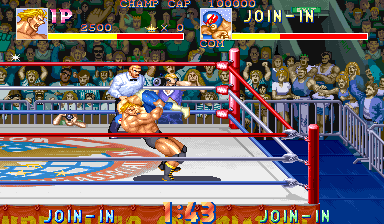
The console versions are pretty similar, but the Genesis version includes a death match option that surrounds the ring in barbed wire or electric ropes. The SNES version looks closest to the arcade and had four player support with the multitap. There was an arcade only pseudo-sequel called Muscle Bomber Duo that improved on the first game, but removed the option for 1-on-1 matches, it's basically Saturday Night Slammasters: Championship Edition. There was then a full-fledged sequel, but it had limited US release (I've never played it), and apparently is a traditional 2D fighter with wrestling ring backgrounds.
Of course, in the '90s, anything Capcom could do, SNK was bound and determined to attempt to do better, so they dropped 3 Count Bout on the Neo-Geo. A fully fictionalized roster with many transparent stand-ins (Terry Rogers is obviously Hulk Hogan with hair, even more obviously when you know Hulk's real name is Terry), but a really oddly great single player that involves death matches and even a parking lot brawl that allows you to grab a backstage interviewer and throw him at your opponent. Unfortunately, the oppressive difficulty, which stems from horrid button mashing that begins to always go in the CPU's favor after about two matches, makes the game pretty unfun, unless you're playing the AVS version and can scale the difficulty down.

The last grappler I remember being released with a fully fictional roster is Power Move Pro Wrestling from Activision for the PS1. It was also the first 3D wrestling game that came to the US. Power Move is actually a rejiggered version of the first New Japan game (Toukon Retsuden) for PS1, basically getting the same treatment as Natsume Championship Wrestling. It's basically WWF Smackdown 0, as it was developed by Yuke's and uses a really primative version of the same engine. It's only interesting as a curio now, as each guy only has about four grapples, there's no single player to speak of, and there's literally no match options besides 1-on-1. The instruction book is kind of neat, though, as they went to the trouble to flesh out all of the fictional grapplers' stories and rivalries.
WCW
I'm gonna be 100% honest with you here, dear reader. WCW's videogame output was about as good as their product, which is to say, it had some high points between 1997 and 1999, but other than that, it was garbage. The first WCW games were developed by Pony Canyon/FCI, and the first one, WCW Wrestling for NES, wasn't even a WCW game when it was developed. It was actually a game called Super Star Pro Wrestling that featured a variety of actual puroresu stars from various Japanese promotions.
The localization is so horrifically bad that even though the Road Warriors (a.k.a. Legion of Doom) are in both games, the version of Hawk in WCW Wrestling is actually Stan Hansen in Super Star Pro Wrestling, while the SSPW version of Hawk somehow became Michael "P.S." Hayes in the American game. The game is overly hard, uses that same button mash-y style and the wrestler's signature moves rarely line up with what their actual finishers were.
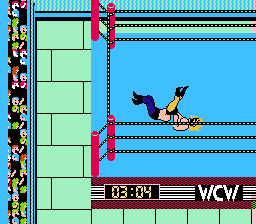
The second Pony Canyon WCW game was years later for the SNES and was called WCW Superbrawl Wrestling. It was actually developed by Beam Software, who gave us Back to the Future II & III for NES. You can imagine what it might be like. The game, quite frankly, is inscrutable. The HUD is crowded and sloppy and the controls are awful. It makes Acclaim's WWF efforts look like Super Mario Bros. 3. It's embarrassing. It should be avoided.

Superbrawl Wrestling's horrific character select screen. Yes, that is Johnny B. Badd you see there.
There were Gameboy games from Pony Canyon, too, but I've never played them. Based on what I know about the console WCW games and wrestling games on the black & white Gameboy, I think I'm better off.
They got better after that for two games, while AKI was handling their N64 output, and I would say that WCW/nWo Revenge is the best wrestling game to not feature a character creation tool. The only problem with these games now is that they are surpassed in every way by the WWF games that AKI made for the N64. I'm also told that AKI's Japan-only follow up, Virtual Pro Wrestling 2 shames these early efforts.
THQ also had some PS1 games (later ported to N64 and PC) developed, but not by AKI or by Yuke's, who would handle their WWE games once they took over that license. The games in question are WCW vs. the World, WCW Nitro and WCW Thunder. I bought Nitro the day it came out, and the friendly guy at Funcoland tried hard to dissuade me. I would not be dissuaded. I can only wish now that I had listened to him.

Developed by Inland Productions, the games both feature horrid graphics, no single player to speak of, an obnoxiously limited move set, and should just generally be avoided. The only redeeming factor are promos you can watch on the character select screen. Seriously, that is the only interesting thing about these games.
WCW vs. the World actually came before those, and was developed by AKI. It plays similarly to their N64 titles, but has fewer moves for each wrestler. Largely forgettable today.
After THQ lost the WCW license, EA won the bid. This is not the EA we know today that released things like Rock Band, Mirror's Edge and Left 4 Dead. No, this was the old, bad EA. This is an EA that released a myriad of awful WCW games, including one that was a wrestling game without a ring. I'll say that again; they released a wrestling game that HAD NO RING.
.gif)
Who needs a ring when you can have a Jeff Jarrett mirror match?
I talked Monday about how bad Wrestlemania XIX for Gamecube was, but at least under all the stupid crap there was a point at which you wrestled. In a wrestling ring. EA, though, they released WCW Backstage Assault. What's the demographic for that, exactly? People surveyed revealed that their favorite part of wrestling programs were the muggings guys gave each other in the backstage areas? Are you joking?
Sadly, faithful readers, they were not. The predecessor, WCW Mayhem had a ring, and was pretty much just as awful. The system was just sloppy. It was a quick cash-in from the old EA. Apparently, they were starting to get it, and handed development of WCW Mayhem 2 to AKI, but, as we know, WWF bought WCW in 2001 and that game never reached shelves. EA would take AKI's beginnings of that game and create Def Jam Vendetta, more on that later.
ECW
ECW was only a strong enough promotion to have two videogames made. Both were done by Acclaim and they were continuations of the WWF Warzone series. It was nice at the time to see Rob Van Dam, Justin Credible and the ECW crew in game format, but the games themselves were derivative, offering little over what WWF Attitude had already offered.

The first game was for PS1, Dreamcast, N64 and Gameboy Color. I've never played the GBC games, but the other versions are entirely skippable in favor of Anarchy Rulz for PS1 and Dreamcast, which, honestly, is also not really worth a lot of your time unless you have some serious ECW nostalgia. Smackdown vs. Raw included ECW in their rosters for the last three years, but there was nothing inherently ECW-esque about the brand in any of those games.
Puroresu
Puroresu games often come to the US with fake casts, as we've discussed. Others just stay in Japan. Most of them we've kind of touched on by this point, but there are two that I want to touch on in particular. The first is a series that was actually done by a first party. Sega produced three All Japan Pro Wrestling games, one for Saturn/arcade, two for Dreamcast. None of them made it out of Japan, which is a shame because they're very, very good.
The first is called All Japan Pro Wrestling featuring Virtua, because it (like the others) featured a couple of characters from Virtua Fighter. It set the tone, but all the games basically build off of the same system and only get better. Giant Gram 2000 for Dreamcast is generally considered the best of the bunch. What makes the games great is the system. It's very basic, using a rock-paper-scissors system which means throws beat grapples, grapples beat attacks, and attacks beat throws.

The thing that makes the game really unique, though, is the combo system. For example, if you are using a character that has a verical suplex, doing a button imput (often down and B) at just the right time turns it into a brainbuster. The reversal system works on a similar principle. Unlike Smackdown vs. Raw, or even No Mercy, wherein you just press the counter button before the grapple, Giant Gram requires the timing on a reversal be perfect to the time of an opportunity for reversal during the manuver. The Dreamcast titles also feature robust create a wrestler modes.

The other puroresu game I wanted to mention is King of Colosseum. It's developed by Spike, who is mostly Human expatriates. It is fully licensed by all the major Japanese wrestling promotions, and uses an extremely deep grappling system. It would be difficult to describe here, and it takes some time to learn, but it's worth it. My favorite thing about the series, though, is it's emphasis on wrestling psychology, something very few games even touch on. In KoC, in order to advance, in order to have a successful match, you must please the crowd. This means letting your opponent get an advantage on you, in order to make a big comeback. I highly recommend the last game in the series, King of Colosseum II, as the first few games break up the federations between them.
Fire Pro Wrestling
A series so well known, so grand, so critically lauded that it deserves its own heading. Fire Pro Wrestling began life on the PC Engine in 1989 with Fire Pro Wrestling Combination Tag, developed and published by Human Entertainment only in Japan. The game was a vast departure from earlier wrestling games in that button mashing was the fastest path to a loss. Fire Pro Wrestling Combination Tag required the player to time their grapples.
When two wrestlers approached each other, they would automatically lock up, after a moment, they would bend their knees. Hitting an attack button exactly at the moment you bent your knees would result in you executing your move, unless you attempted a move that was too powerful too early, and you opponent attempted a weaker, faster move. Over time, the only change to this system is that in more recent games, the wrestlers now rear back before lunging forward and locking up, and now the correct timing is exactly when you make contact for the lockup. Other than that, the basic system is the same.
Naturally, with more games came more moves, taunts, entrances, more wrestlers in the ring and, perhaps most importantly, a more robust single player experience. Several of the games feature very fully developed stories, not only for their time, but for wrestling games in general. In fact, if you've ever wondered why Suda51 puts wrestling moves and references in so many of his games, it's because he got his start as a scenario writer for Human working on the Fire Pro series. In fact, he set the tone for his work pretty early when he wrote the scenario for Super Fire Pro Wrestling Premium for the Super Famicom (Japanese Super NES). In that game, your character falls in love with Akira Maeda's (fictional) sister, but the love goes unrequited and after winning the World Heavyweight Championship, he kills himself.
.gif)
Speaking of the player characters, each Fire Pro entry has a pretty large cast, with the most recent having over three hundred characters, with slots to create over one hundred more. The characters themselves aren't really fictionalized versions of real wrestlers. No, they're more like real, actual wrestlers with different names. They look, taunt, fight and use the finishers of their real life counterparts, and there are entire FAQs online dedicated to helping you go through the (extremely tedious) task of renaming all the characters to their real names.
The series has well over twenty entries, so discussing them all here is nearly impossible, but rest assured, this is not a series in which the most recent entry is the only one worth playing. In fact, while Fire Pro Wrestling Returns for the PS2 is by far the best game from a mechanics standpoint, it is woefully light on single player modes. That being said, it's the only console game in the series to get a US release, and at release it was only twenty bucks, so there's not a compelling reason to not own it, if you're into wrestling and videogames. Still, though, the major draw in terms of single player is a mode in which you become a promoter and book shows and can play out all of your matches. The only problem with it is you can't use your edits (created characters in Fire Pro lingo) in this mode, and making edits is one of the biggest draws to the game, so the mode becomes much less compelling.

The casts also vary from game to game, including one game for the PC Engine Duo that is entirely a Joshi (Japanese women's wrestling) game. Fire Pro Wrestling D for Dreamcast is also very highly regarded, as well as Super Fire Pro Wrestling X Premium. The first taste we got of the series wasn't until the 2001 launch of the Gameboy Advance, and the two games that got US release (Fire Pro Wrestling and Fire Pro Wrestling 2) are also very good, and portable, which is a bonus! The only shame there is that Fire Pro Wrestling 2's biggest draw was it's Management of the Ring mode, which put you even more in the shoes of a promoter than Fire Pro Wrestling Returns single player, as it required you to buy TV time, develop merch, etc. was cut due to the amount of work the (small) US publisher would've had to sink into localization.

Spike, the current owner of the Fire Pro series (made up mostly of Human expats, following that company's dissolution) have said that Fire Pro Wrestling Returns is the last in the series, but I have my doubts (and hopes!) that that isn't true.
Miscellany
I know I didn't cover every single non-WWE wrestling game here, but this post is already crazy long, and I didn't think it needed to be any longer. Still, there are a few games that don't fit into any of the above categories that I think need to be addressed. Just a quick rundown of some other games out there.
The first is TNA Impact. I had high hopes for this game. I read many developer interviews in which I was told the team was basically trying to recapture what made WWF No Mercy great while adding a modern design sensability. This did not happen. In fact, I'm not sure if the team had even played No Mercy, because this game was nothing like it, and while it was, I guess, playable at best, it was repetative with a wonky grapple system. Still, it was better than having to watch TNA, so that's something. It was done by Midway, who has since dissolved (and there are rumors that this game's high investment and low sales were a factor in that), so I'm not sure who has the TNA license now or if we'll even see another game.
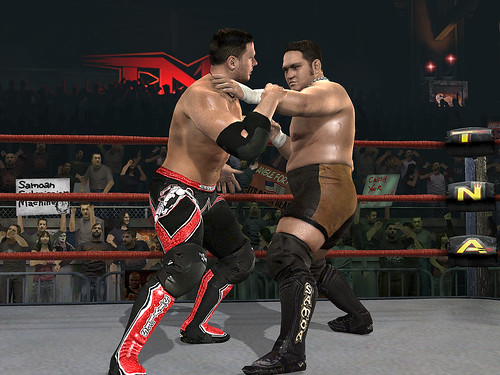
Looks good. Plays horribly.
To move on to a pair of games that actually did resemble No Mercy, let's talk about the first two Def Jam games for a second. Def Jam Vendetta was a wrestling game featuring rappers, developed my No Mercy developer AKI. I'm not sure that there's much more that needs to be said here. It's a follow up to No Mercy in which I can play as Method Man. Sold. On the filp side, there's no create modes, so you're stuck with the default roster. By all accounts, this is what became of WCW Mayhem 2 after EA was stuck without a WCW license.
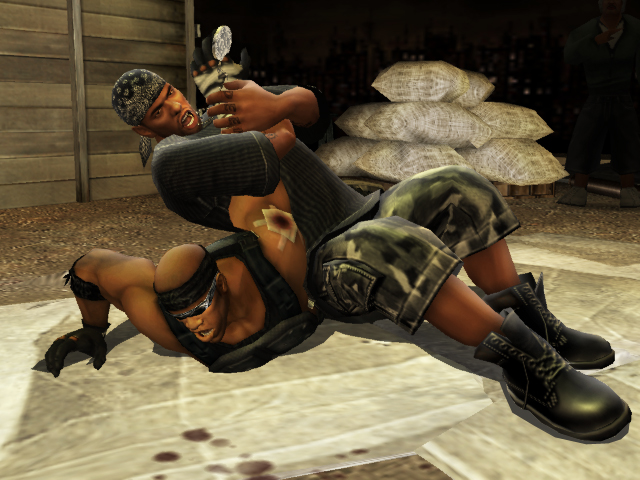
The game was successful, so EA put AKI right back to work and they came up with Def Jam: Fight for NY. At this point, you might be calling foul on me for talking bad about Backstage Assault, as by all appearances, this is a wrestling game without a wrestling ring. Not really. It's a game that came from wrestling games, but actually uses only KOs and submissions to end fights. It's really more of a fighting game informed by wrestling games.
AKI fixed most everything that was wrong with Def Jam Vendetta (which is to say, they added a create mode) and added former Black Flag frontman and spoken word genius Henry Rollins as a playable character. Again, sold. A game that allows for grudge matches between Henry Rollins and Dr. Foreman from "House, M.D." is automatically awesome. The game could've stood to have a ring, but still, it's very solid and it's from AKI. You can't go wrong. The third Def Jam game was handed to EA Chicago, was terrible, bombed and led to the shutdown of that studio. Let's not talk about it.
Speaking of things we shouldn't talk about, Eidos released two Backyard Wrestling games. They are literally games in which you wrestle in backyards. They feature members of the Insane Clown Posse as playable characters. You should stay far, far away from these games. They are an insult to both wrestling and backyards. In fact, in that way they are surprisingly faithful to their source material.
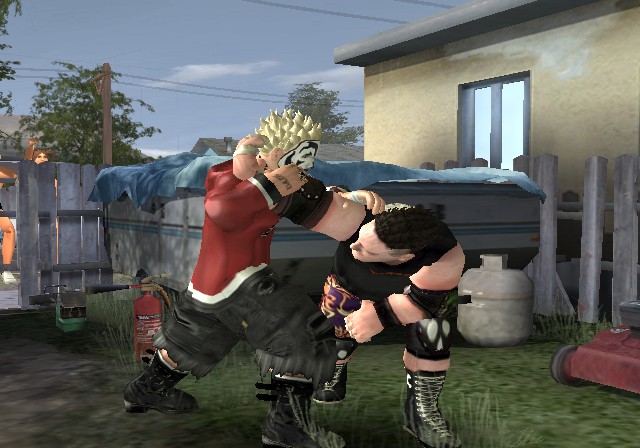
A real juggalo wouldn't fuck around with a wristlock, and a real backyarder can't do one.
There is only one lucha libre game I'm aware of, and it's not even out yet. Initially announced as AAA: El Videojuego, it's now known as Lucha Libre AAA 2010: El Heroes del Ring (Pro Wrestling AAA 2010: Heroes of the Ring). It's being developed by Immersion Software & Graphics and published by Slang. I am not familiar with either of those companies. I can only hope it isn't vaporware, because, as you can see by the body of this article, lucha libre in videogames is woefully under-represented.
So that's it. That's your primer for wrestling games. I know I left some out (Konami's Rumble Roses series, Yuke's Japan-only Wrestle Kingdom series, that crappy All-Star series Square-Enix did in Japan), but I think this post is enough to keep almost anyone busy for at least a little while. Check back tomorrow when I bring you a double dose of Top Five Friday for Wrestlemania Week!
LINKS
Hardcore Gaming 101's SNK Wrestling Games article
Hardcore Gaming 101's Saturday Night Slammaster's article
Hardcore Gaming 101's All Japan Pro Wrestling Games article
Hardcore Gaming 101's Pro Wrestling (NES) article
The Fire Pro Club
Wikipedia's Fire Pro Wrestling page
Monday, March 22, 2010
Wrestle(videogame)mania Week: WWE Games and Publishers
The road to Wrestlemania ends this weekend in Phoenix with Wrestlemania XXVI. As anyone who knows me is already aware, I have a completely un-ironic and sincere love for the art form of professional wrestling (yes, I think it is an art form, and yes, I would love to debate that). I also have a completely un-ironic and sincere love for professional wrestling videogames. This week is a perfect opportunity to meld my loves. Today I'll talk about the WWF/E's relationship with videogames, Wednesday will be a primer on non-WWE wrestling games (including some puroresu games) and Friday will be a special double Top Five Friday centered around wrestling games. On Saturday, I'll put up a bonus post which will be a Wrestlemania preview just like the one I did last year. Without further ado, let's talk about WWE games.
The Acclaim/LJN Era
The first publisher to lay claim to WWF's games was Acclaim. Some of the games were released under the Acclaim name, some under the LJN imprint (Acclaim's way of getting around Nintendo of America's five games a year rule), nearly all were horrid. The first one released and the first one I remember playing was WWF Wrestlemania for the NES. If Wikipedia is to be believed, it was actually programmed by Rare, and if that is the case, it is Rare's worst game. Even worse than Perfect Dark Zero.

The game featured very few wrestlers, almost no grappling and a ridiculous difficulty curve. For NES gamers who had already played Pro Wrestling, it was a big step down. Unfortunately, the rest of Acclaim's NES output showed minimal improvement at best. Their 16-bit titles got a little better, culminating in Rage in the Cage, which almost no one played, as it was a Sega CD title, but it was essentially the same as the semi-highly regarded Royal Rumble for SNES & Genesis, but with FMV and more wrestlers.
In the late '90s, Acclaim went through a house cleaning and attempted to revamp their image. It kind of, sort of worked. It was around this time that we saw Turok: Dinosaur Hunter (lauded at the time, but pretty crappy in hindsight) and Acclaim's last two WWF releases, Warzone and Attitude, the former for PS1 and N64, the latter for PS1, N64 and Dreamcast.

They were very much the same game in terms of gameplay, using fighting game-esque button combos to execute wrestling moves. Attitude was the first wrestling game I remember playing that both had a robust character creation mode (Warzone feature a mode for this, but options for looks were sparse and movesets were all premade) and a story mode that semi-closely resembled actual wrestling programming. It included grudge matches and a climb from b-rate shows like Shotgun Saturday Night up to pay-per-view events like Wrestlemania. Still, as with Acclaim's other releases from the time, they've both aged pretty poorly, and are only worth checking out for nostalgia or curosity's sake.
The Ocean Era
Ocean Software made a few WWF games for gaming PCs/microcomputers in the late '80s and early '90s. The only one of these I've played is the DOS version of WWF European Rampage Tour, based on the tour of the same name. It was pretty bad, if memory serves, but the digitized Sean Mooney speech between matches was kinda neat for the time. The graphics shamed any of Acclaim's NES releases, but the gameplay was pretty well par for the course (which is to say, bad). Not much else to say, really.

The Technos Era
Now this is where WWF games get good. Technos, one of my all-time favorite developers in both the arcade and on consoles, the fine folks behind Double Dragon and River City Ransom, had the WWF license for two glorious games, one of which is still considered by some to be the best WWF game ever made.
The first was WWF Superstars, which should not, under any circumstances, be confused with Acclaim's awful WWF Superstars for the Gameboy. Superstars featured eight wrestlers total, six playable ("The Million Dollar Man" Ted DiBiase and Andre the Giant are the boss team) and features only tag team play. It followed the semi-standard button mash style of gameplay popular at the time for grapplers, but the button mashes weren't nearly as hard to win against the CPU as later games like Three Count Bout.

The second is still one of the most beloved WWF games to come out, WWF Wrestlefest. Wrestlefest featured a much larger roster, much larger, more detailed sprites, and even some digitized live commentary. It was released two years later, and features twelve wrestlers, ten of which are playable (the Legion of Doom are non-playable bosses). Each wrestler has a unique set of moves, resulting in many more moves overall compared to Superstars, which had a fairly standard set for all the superstars.

In terms of play modes, it features a mode based on Saturday Night's Main Event, in which you (and a friend?) choose a tag team and try to take the Tag Team Titles from Hawk and Animal, the Legion of Doom. The other mode, which was a big deal at the time, is Royal Rumble, in which you (and up to three friends) choose superstars and have to eliminate everyone to be the last man standing. They're a little loosey-goosey with the rules of the Rumble, allowing pinfalls as well as the real Royal Rumble rule of throwing your opponent over the top rope to eliminate them.
Overall, Technos did a great job with the WWF license. Unfortunately, they only had two releases, and neither of them ever saw a console port. But I wouldn't blame you if you used MAME to play them.
The Midway Era
This era consists of exactly one game: WWF Wrestlemania. It was an arcade game that may as well have been called WWF Jam, since it's to WWF what NBA Jam and NFL Blitz are to basketball and football, respectively. Still, the game is a remarkable bit of fun, even if it can be beaten in about fifteen minutes on the hardest difficulty and only features eight playable wrestlers. It was ported to consoles by Acclaim, as they had both the WWF license and a deal with Midway to port their arcade games. The SNES version is gimped significantly, supporting only three characters on screen at a time and cutting Yokozuna and Bam Bam Bigelow entirely.

Following that game, Acclaim did an in house sequel, only for consoles, ironically called WWF In Your House, based on what the off-month pay-per-views (the ones that weren't Wrestlemania, King of the Ring, Summerslam, Survivor Series or the Royal Rumble) were called at the time. It added four player support, but killed everything else. The graphics were awful, the controls were sluggish and the special moves were much harder to pull off. Leave it to Acclaim to take someone else's good idea and ruin it.
The THQ Era
THQ are the current holders of the license, and they've been busy, busy, busy. The flagship series for them is the Smackdown vs. Raw series, which started simply as the Smackdown series. It began life on PS1, with two releases that were developed by Yuke's, a development house which seems to specialize in pro wrestling games. They were pretty well known in Japan for the Toukon Retsuden series, which were games based on the New Japan Pro Wrestling promotion.
Before that, they were known for their collaborations with developer AKI, who, before partnering with WWF, were responsible for WCW/nWo World Tour and WCW/nWo Revenge on the N64. AKI used the same engine for the two N64 WWF releases they did that were published by THQ. Those games were Wrestlemania 2000 and No Mercy. No Mercy is considered by fans of wrestling videogames to be among the greatest ever, if not the greatest ever. It's pacing, character creation tools, number of moves, branching storylines and myriad of unlockable content make it legendary amongst fans of the genre. If you like wrestling, No Mercy is reason enough to keep your N64. AKI went on to develop the first two Def Jam games for EA, then the Ultimate Muscle/Kinnikuman games.

On the Xbox front, THQ released two games in the Raw series, both by Anchor that were middling at best. They followed that up with Wrestlemania 21, which was mediocre by all accounts. After that, they just decided to go with the sure thing, and with the Xbox 360, they've just been releasing entries in the previously Playstation exclusive Smackdown vs. Raw series.
That series is also on the Wii now, but previously there had been a number of games on the Gamecube. They were all a bit different, with the biggest sore thumb being Wrestlemania XIX, which featured a really dumb storyline (even for a wrestling game) which basically turned the game into a Final Fight-style brawler, with you beating guys up at constructions sites and the like. It was dumb. Never play it. THQ and Yuke's did, however, finish the Gamecube era in a strong fashion with the two Day of Reckoning titles. With a similiar, but not congruent system to Smackdown vs. Raw, the Day of Reckoning titles feature a strong emphasis on story, the second game being particularly notable as it's one of the very few grapplers I can think of that starts you as the champion, then sets you on a quest to regain your title, instead of making you the wet behind the ears rookie out to prove himself and win the title.
THQ also did two GBA titles that are not great alone, but entirely un-necessary when you realize that the first two Fire Pro Wrestling releases to come to the US were on the GBA. They later experimented with other genres, including an ill-advised foray into the car combat genre with WWE Crush Hour. One odd little experiment that's surprisingly solid is WWF Betrayal, which, despite what I said about Wrestlemania XIX, is a Final Fight-style (really more Mighty Final Fight-style) brawler that works really well. You choose one of four characters (Undertaker, Stone Cold, Triple H or The Rock) and punch and kick dudes, occasionally busting our your finishing move. It's dumb and easy, but it's fun in the way the most beat-'em-ups are.

So that's my tour of WWF/WWE's videogame history. Yes, I know I didn't cover every single game, but it's just an overview. If you're really curious, check the link at the bottom of the page. Stay tuned on Wednesday for an intro to non-WWE games!
LINKS:
Wikipedia's WWE game list
The Acclaim/LJN Era
The first publisher to lay claim to WWF's games was Acclaim. Some of the games were released under the Acclaim name, some under the LJN imprint (Acclaim's way of getting around Nintendo of America's five games a year rule), nearly all were horrid. The first one released and the first one I remember playing was WWF Wrestlemania for the NES. If Wikipedia is to be believed, it was actually programmed by Rare, and if that is the case, it is Rare's worst game. Even worse than Perfect Dark Zero.

The game featured very few wrestlers, almost no grappling and a ridiculous difficulty curve. For NES gamers who had already played Pro Wrestling, it was a big step down. Unfortunately, the rest of Acclaim's NES output showed minimal improvement at best. Their 16-bit titles got a little better, culminating in Rage in the Cage, which almost no one played, as it was a Sega CD title, but it was essentially the same as the semi-highly regarded Royal Rumble for SNES & Genesis, but with FMV and more wrestlers.
In the late '90s, Acclaim went through a house cleaning and attempted to revamp their image. It kind of, sort of worked. It was around this time that we saw Turok: Dinosaur Hunter (lauded at the time, but pretty crappy in hindsight) and Acclaim's last two WWF releases, Warzone and Attitude, the former for PS1 and N64, the latter for PS1, N64 and Dreamcast.

They were very much the same game in terms of gameplay, using fighting game-esque button combos to execute wrestling moves. Attitude was the first wrestling game I remember playing that both had a robust character creation mode (Warzone feature a mode for this, but options for looks were sparse and movesets were all premade) and a story mode that semi-closely resembled actual wrestling programming. It included grudge matches and a climb from b-rate shows like Shotgun Saturday Night up to pay-per-view events like Wrestlemania. Still, as with Acclaim's other releases from the time, they've both aged pretty poorly, and are only worth checking out for nostalgia or curosity's sake.
The Ocean Era
Ocean Software made a few WWF games for gaming PCs/microcomputers in the late '80s and early '90s. The only one of these I've played is the DOS version of WWF European Rampage Tour, based on the tour of the same name. It was pretty bad, if memory serves, but the digitized Sean Mooney speech between matches was kinda neat for the time. The graphics shamed any of Acclaim's NES releases, but the gameplay was pretty well par for the course (which is to say, bad). Not much else to say, really.

The Technos Era
Now this is where WWF games get good. Technos, one of my all-time favorite developers in both the arcade and on consoles, the fine folks behind Double Dragon and River City Ransom, had the WWF license for two glorious games, one of which is still considered by some to be the best WWF game ever made.
The first was WWF Superstars, which should not, under any circumstances, be confused with Acclaim's awful WWF Superstars for the Gameboy. Superstars featured eight wrestlers total, six playable ("The Million Dollar Man" Ted DiBiase and Andre the Giant are the boss team) and features only tag team play. It followed the semi-standard button mash style of gameplay popular at the time for grapplers, but the button mashes weren't nearly as hard to win against the CPU as later games like Three Count Bout.
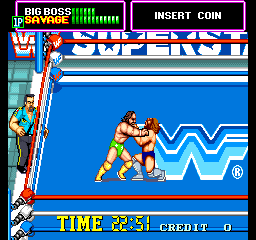
The second is still one of the most beloved WWF games to come out, WWF Wrestlefest. Wrestlefest featured a much larger roster, much larger, more detailed sprites, and even some digitized live commentary. It was released two years later, and features twelve wrestlers, ten of which are playable (the Legion of Doom are non-playable bosses). Each wrestler has a unique set of moves, resulting in many more moves overall compared to Superstars, which had a fairly standard set for all the superstars.
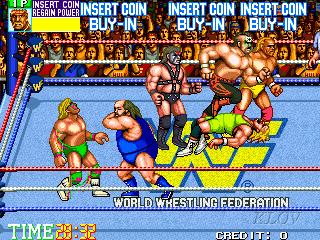
In terms of play modes, it features a mode based on Saturday Night's Main Event, in which you (and a friend?) choose a tag team and try to take the Tag Team Titles from Hawk and Animal, the Legion of Doom. The other mode, which was a big deal at the time, is Royal Rumble, in which you (and up to three friends) choose superstars and have to eliminate everyone to be the last man standing. They're a little loosey-goosey with the rules of the Rumble, allowing pinfalls as well as the real Royal Rumble rule of throwing your opponent over the top rope to eliminate them.
Overall, Technos did a great job with the WWF license. Unfortunately, they only had two releases, and neither of them ever saw a console port. But I wouldn't blame you if you used MAME to play them.
The Midway Era
This era consists of exactly one game: WWF Wrestlemania. It was an arcade game that may as well have been called WWF Jam, since it's to WWF what NBA Jam and NFL Blitz are to basketball and football, respectively. Still, the game is a remarkable bit of fun, even if it can be beaten in about fifteen minutes on the hardest difficulty and only features eight playable wrestlers. It was ported to consoles by Acclaim, as they had both the WWF license and a deal with Midway to port their arcade games. The SNES version is gimped significantly, supporting only three characters on screen at a time and cutting Yokozuna and Bam Bam Bigelow entirely.
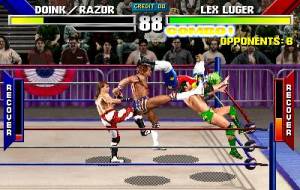
Following that game, Acclaim did an in house sequel, only for consoles, ironically called WWF In Your House, based on what the off-month pay-per-views (the ones that weren't Wrestlemania, King of the Ring, Summerslam, Survivor Series or the Royal Rumble) were called at the time. It added four player support, but killed everything else. The graphics were awful, the controls were sluggish and the special moves were much harder to pull off. Leave it to Acclaim to take someone else's good idea and ruin it.
The THQ Era
THQ are the current holders of the license, and they've been busy, busy, busy. The flagship series for them is the Smackdown vs. Raw series, which started simply as the Smackdown series. It began life on PS1, with two releases that were developed by Yuke's, a development house which seems to specialize in pro wrestling games. They were pretty well known in Japan for the Toukon Retsuden series, which were games based on the New Japan Pro Wrestling promotion.
Before that, they were known for their collaborations with developer AKI, who, before partnering with WWF, were responsible for WCW/nWo World Tour and WCW/nWo Revenge on the N64. AKI used the same engine for the two N64 WWF releases they did that were published by THQ. Those games were Wrestlemania 2000 and No Mercy. No Mercy is considered by fans of wrestling videogames to be among the greatest ever, if not the greatest ever. It's pacing, character creation tools, number of moves, branching storylines and myriad of unlockable content make it legendary amongst fans of the genre. If you like wrestling, No Mercy is reason enough to keep your N64. AKI went on to develop the first two Def Jam games for EA, then the Ultimate Muscle/Kinnikuman games.

On the Xbox front, THQ released two games in the Raw series, both by Anchor that were middling at best. They followed that up with Wrestlemania 21, which was mediocre by all accounts. After that, they just decided to go with the sure thing, and with the Xbox 360, they've just been releasing entries in the previously Playstation exclusive Smackdown vs. Raw series.
That series is also on the Wii now, but previously there had been a number of games on the Gamecube. They were all a bit different, with the biggest sore thumb being Wrestlemania XIX, which featured a really dumb storyline (even for a wrestling game) which basically turned the game into a Final Fight-style brawler, with you beating guys up at constructions sites and the like. It was dumb. Never play it. THQ and Yuke's did, however, finish the Gamecube era in a strong fashion with the two Day of Reckoning titles. With a similiar, but not congruent system to Smackdown vs. Raw, the Day of Reckoning titles feature a strong emphasis on story, the second game being particularly notable as it's one of the very few grapplers I can think of that starts you as the champion, then sets you on a quest to regain your title, instead of making you the wet behind the ears rookie out to prove himself and win the title.
THQ also did two GBA titles that are not great alone, but entirely un-necessary when you realize that the first two Fire Pro Wrestling releases to come to the US were on the GBA. They later experimented with other genres, including an ill-advised foray into the car combat genre with WWE Crush Hour. One odd little experiment that's surprisingly solid is WWF Betrayal, which, despite what I said about Wrestlemania XIX, is a Final Fight-style (really more Mighty Final Fight-style) brawler that works really well. You choose one of four characters (Undertaker, Stone Cold, Triple H or The Rock) and punch and kick dudes, occasionally busting our your finishing move. It's dumb and easy, but it's fun in the way the most beat-'em-ups are.

So that's my tour of WWF/WWE's videogame history. Yes, I know I didn't cover every single game, but it's just an overview. If you're really curious, check the link at the bottom of the page. Stay tuned on Wednesday for an intro to non-WWE games!
LINKS:
Wikipedia's WWE game list
Sunday, January 11, 2009
Visual Storytelling in Wrestling
I hate the JBL/HBK storyline that's going on on Raw right now, but probably not for the reasons you might think. Yes, I'll concede that it's stupid for us, as viewers, to be expected to believe that Shawn Michaels is so broke that his multi-million dollar salary can't sustain him and his family. Yes, it's stupid for us to be expected to believe that JBL is that rich that he can afford to pay Shawn so much more than his already multi-million dollar salary as to make it worth it to him to compromise his principles.
But that's not why I hate the angle.
I hate the angle because aside from two in ring occurences (HBK slaps JBL, thereby getting Rey Mysterio DQ'd from his Fatal Fourway qualifying match, and HBK takes the Clothesline from Hell without defending himself, allowing JBL to win the aforementioned Fatal Fourway), the entire story has been furthered by talking. JBL talks to the crowd, Todd Grisham talks to HBK, HBK talks to the crowd, HHH talks to HBK, Jericho & Orton talk to JBL, JBL talks to HBK, HBK talks to Cena... STOP TALKING!
Much like in my "Visual Storytelling in Videogames" essay, I want to clarify that I do not hate promos and backstage vignettes. Promos have a function, and have since pro-wrestling began, even moreso since pro-wrestling began on TV (which is not long after anything began on TV), but until the late '90s, they were used much more sparingly. The late '90s were the heyday of the promo, featuring editions of both Raw and Nitro that did not have so much as an arm drag until 45 minutes in. Thankfully, those days are over, but there's still some holdover.
Holdover like the HBK/JBL storyline. Now, HBK and JBL are two of the best "stick men" (i.e. guys who cut good promos) in wrestling today. In fact, I would argue that JBL's at his very best when he's cutting a promo, and he could make a great manager when he decides to leave the ring for good, but that doesn't change the fact that having a storyline play out almost exclusively in the realm of the promo is just lazy storytelling.
It was even revealed that HBK was in JBL's employ in a promo. Can you think of a bigger waste? He could've screwed Rey by slapping JBL before anyone knew he was working for him, then explained in a brief promo that he did it to save JBL's title chances because "blah, blah, blah, I'm a broke millionaire."
He could've saved JBL from a beatdown. He could've done something as simple as putting JBL's foot on the rope when he was being pinned during a match, any match, really. What did WWE's brilliant writing staff come up with instead? "Shawn Michaels works for me now."
Wow. That's some riveting television, that is. Nothing like a goof in a cowboy hat telling me he hired another goof in a cowboy hat. Puts me right on the edge of my seat, that does. How come these guys didn't win any Golden Globes tonight?
On the flip side, let's look at the Jake "The Snake" Roberts/"Ravishing" Rick Rude feud of 1988. It starts with a promo, but one with a good hook. Rude hits on a pretty girl, she turns out to be Mrs. "The Snake." Simple, short, to the point, right? Right. Roberts runs out, punches Rude (Action! How novel of a concept!), a bunch of "enhancement talent" runs out and pulls them apart.
Following that incident, Rude gets some tights with Mrs. Snake's face on them, Roberts warns in a very brief promo that he shouldn't do it again, Rude does, Roberts comes to the ring and pulls them off in front of a live audience following a match. The two have a match at Saturday Night's Main Event in October, Roberts wins, starts a feud with Andre the Giant.
Now, of course, that's a simplification of the events of that feud, but a simplification of this one would read "JBL and HBK talk about HBK working for JBL. HBK slaps JBL, then takes a dive to him in a Fatal Fourway for a title match at the Royal Rumble."
The point is that visual storytelling is not the difficult, especially in a media that are so given to it in the first place. Aural storytelling is not effective in wrestling, it never has been, and it never will be. The crowds are too big and putting lapel mics on the wrestlers would be impossible unless they all dressed like Rick Martel (yes, he is a model).
Wrestling is pure visual storytelling. A great match will always be a great match, regardless of context, because the two (or four or six or sometimes ten) guys in the ring will tell it. A great promo, though? Well, no matter how great it is, without context, you won't know what the guy is talking about, even if he sounds good doing it.
But that's not why I hate the angle.
I hate the angle because aside from two in ring occurences (HBK slaps JBL, thereby getting Rey Mysterio DQ'd from his Fatal Fourway qualifying match, and HBK takes the Clothesline from Hell without defending himself, allowing JBL to win the aforementioned Fatal Fourway), the entire story has been furthered by talking. JBL talks to the crowd, Todd Grisham talks to HBK, HBK talks to the crowd, HHH talks to HBK, Jericho & Orton talk to JBL, JBL talks to HBK, HBK talks to Cena... STOP TALKING!
Much like in my "Visual Storytelling in Videogames" essay, I want to clarify that I do not hate promos and backstage vignettes. Promos have a function, and have since pro-wrestling began, even moreso since pro-wrestling began on TV (which is not long after anything began on TV), but until the late '90s, they were used much more sparingly. The late '90s were the heyday of the promo, featuring editions of both Raw and Nitro that did not have so much as an arm drag until 45 minutes in. Thankfully, those days are over, but there's still some holdover.
Holdover like the HBK/JBL storyline. Now, HBK and JBL are two of the best "stick men" (i.e. guys who cut good promos) in wrestling today. In fact, I would argue that JBL's at his very best when he's cutting a promo, and he could make a great manager when he decides to leave the ring for good, but that doesn't change the fact that having a storyline play out almost exclusively in the realm of the promo is just lazy storytelling.
It was even revealed that HBK was in JBL's employ in a promo. Can you think of a bigger waste? He could've screwed Rey by slapping JBL before anyone knew he was working for him, then explained in a brief promo that he did it to save JBL's title chances because "blah, blah, blah, I'm a broke millionaire."
He could've saved JBL from a beatdown. He could've done something as simple as putting JBL's foot on the rope when he was being pinned during a match, any match, really. What did WWE's brilliant writing staff come up with instead? "Shawn Michaels works for me now."
Wow. That's some riveting television, that is. Nothing like a goof in a cowboy hat telling me he hired another goof in a cowboy hat. Puts me right on the edge of my seat, that does. How come these guys didn't win any Golden Globes tonight?
On the flip side, let's look at the Jake "The Snake" Roberts/"Ravishing" Rick Rude feud of 1988. It starts with a promo, but one with a good hook. Rude hits on a pretty girl, she turns out to be Mrs. "The Snake." Simple, short, to the point, right? Right. Roberts runs out, punches Rude (Action! How novel of a concept!), a bunch of "enhancement talent" runs out and pulls them apart.
Following that incident, Rude gets some tights with Mrs. Snake's face on them, Roberts warns in a very brief promo that he shouldn't do it again, Rude does, Roberts comes to the ring and pulls them off in front of a live audience following a match. The two have a match at Saturday Night's Main Event in October, Roberts wins, starts a feud with Andre the Giant.
Now, of course, that's a simplification of the events of that feud, but a simplification of this one would read "JBL and HBK talk about HBK working for JBL. HBK slaps JBL, then takes a dive to him in a Fatal Fourway for a title match at the Royal Rumble."
The point is that visual storytelling is not the difficult, especially in a media that are so given to it in the first place. Aural storytelling is not effective in wrestling, it never has been, and it never will be. The crowds are too big and putting lapel mics on the wrestlers would be impossible unless they all dressed like Rick Martel (yes, he is a model).
Wrestling is pure visual storytelling. A great match will always be a great match, regardless of context, because the two (or four or six or sometimes ten) guys in the ring will tell it. A great promo, though? Well, no matter how great it is, without context, you won't know what the guy is talking about, even if he sounds good doing it.
Sunday, December 14, 2008
Koslov's Headbutt (or Striking Moves as Finishers in Pro Wrestling)
I have a lot of issues with pro-wrestling today (starting with the fact that almost no one calls it "pro-wrestling" anymore), but the biggest one, the absolute biggest one right now, is Koslov's headbutt. Yeah, I know, seems silly, but let's dissect this for a minute.
Koslov wrestles a guy for anywhere from 2-15 minutes, and at the end of it, he headbutts the guy in the chest and pins him. They call it "The Battering Ram." Why does this work? Ok, bare with me here, but I'm going somewhere with this. Let's take Umaga. Not the greatest performer ever, but miles better than Koslov. Now, we all know that wrestling's internal logic dictates that Samoans have incredibly hard heads (except the Rock, but he must've gotten the recessive "less hard head" gene because he's not full-blooded Samoan), and if he headbutts someone IN THE HEAD, they still don't go down for a three-count.
At what point does a headbutt, ahem, sorry, Battering Ram to the chest outclass and outdamage all the big slams and suplexes this "Sambo Champion" has been dealing out the entire match? And if his head is that hard, why does getting rammed into the turnbuckle faze him at all? Hell, why does getting punched in the head, or even getting hit with a folding chair faze this concrete-skulled monster? I mean, several of the biggest stars in WWE are getting dropped by a HEADBUTT TO THE CHEST.
And this isn't the first time something like this has happened, either. Oh, no. Exhibit A: "Hands of Stone" Ronnie Garvin. Ronnie Garvin, whose work I've never much cared for, used The Knockout Punch as his finisher during his NWA days. The Knockout Punch? So, what, exactly, differentiates "a punch" from "The Knockout Punch"? The only thing I can see is that one comes at the end of a match, the other comes every other second in Garvin's matches.
If Ronnie Garvin can K.O. a guy with a single punch, why doesn't the guy go down the first time he's punched in the head by Garvin? Why aren't ALL of his punches Knockout Punches? And even if there's something different about this supposed Knockout Punch, why does he have to wait until he's exhausted and beat up to use it? Wouldn't he be more likely to hit a good shot right at the beginning of the match? As you can see, this punch leaves a lot of unanswered questions.
You know what's really sad, though? It gets worse with Garvin. Oh, yeah, when he came to the WWF they gave him a new, yet somehow even dumber finisher. The Garvin Stomp. You read that right; The Garvin Stomp. This is where Garvin would systematically stomp on every extremity of this opponent, both arms, both legs, and, finally, their head. It's horrible. If your opponent will lay still long enough for you to walk around him and step on every part of them, wouldn't you just be able to pin them? Moreover, why wouldn't every other stomp cripple them? It's not as if Garvin didn't stomp at all throughout the match before the finish.
Yes, Randy Orton uses this same move now. They call it "The Orton Stomp," but it'll always be The Garvin Stomp, no matter how many good performers actually opt to use it. The differences with Orton are 1) he doesn't use it as a finisher and 2) he actually drops a knee on his opponent's face at the end. I mean, this doesn't save it from being the dumbest move in Orton's arsenal, and making me question if he really is one of the five best performers out there today, but it does make it less painful to watch.
Exhibit B: Johnny B. Badd. Yes, during Marc Mero's tenure with WCW, his finisher was The Tutti Frutti Left Hook. Now, this actually kind of makes sense, as Mero is an ex-boxer, however, he did exactly what Garvin did and punched from the opening bell. Shouldn't all of his punches have much more power than the average wrestler? Shouldn't any non-jab from Mero send his opponent reeling? Yes, yes it should, but it didn't.
Exhibit C: "Big" John Studd. John Studd was one of the best big men in the history of pro-wrestling, but his finisher... well, it was one of the worst. The Heart Punch saw Studd put his opponent in the turnbuckle and punch them in the chest. This supposedly caused some sort of borderline apoplexy, and allowed Studd to make the pin. The only problem is, if he's strong enough that his punches cause minor heart attacks, if directed at the head, as they were throughout matches, shouldn't they also cause the loss of both teeth and conciousness? I'm inclined to say yes. You've probably guessed by now that they didn't.
Now, I'm sure some people are thinking "but, Joe, what about the Superkick (a.k.a. Sweet Chin Music)? What about Kofi Kingston's Jamaican Buzzsaw? What about 'Bad News' Brown's Ghetto Blaster?"
To those people I say the following: those moves are all very specific kicks that require a very specific setup and have a very specific target, i.e. the head. In general in the wrestling business, kicks to the head are portrayed as very damaging, even when they're not finishing moves. You won't EVER see Shawn Michaels kick someone in the head during the course of a match prior to the finish. Brown's Ghetto Blaster was a leaping kick to the back of the head, and you wouldn't see anything like that in any of his matches prior to the finish.
So, back to Koslov and his headbutt. Are we really expected to believe that this headbutt is as devastating as The Pedigree or Tombstone Piledriver or legdrop? Well... ok, forget about that last one, but the answer, apparently, is yes, we are expected to believe it. And tonight, at Judgment Day, there's a good chance Koslov is going to beat Matt Hardy, someone who's been with the company for nearly a decade (with only a brief absence for that RoH thing, but I'm not entirely convinced that wasn't planned to further the Edge feud anyways) with a headbutt. Matt Hardy deserves better than that, and so does the WWE audience. Taz used a suplex as a finisher during his ECW days. Shelton Benjamin uses one now. Koslov's a "Sambo Champion," so why can't they just give him a devastating suplex (belly-to-belly off the top rope, perhaps?) as a finish, and stop making their top guys look like weaklings for getting pinned on a headbutt to the chest?
Koslov wrestles a guy for anywhere from 2-15 minutes, and at the end of it, he headbutts the guy in the chest and pins him. They call it "The Battering Ram." Why does this work? Ok, bare with me here, but I'm going somewhere with this. Let's take Umaga. Not the greatest performer ever, but miles better than Koslov. Now, we all know that wrestling's internal logic dictates that Samoans have incredibly hard heads (except the Rock, but he must've gotten the recessive "less hard head" gene because he's not full-blooded Samoan), and if he headbutts someone IN THE HEAD, they still don't go down for a three-count.
At what point does a headbutt, ahem, sorry, Battering Ram to the chest outclass and outdamage all the big slams and suplexes this "Sambo Champion" has been dealing out the entire match? And if his head is that hard, why does getting rammed into the turnbuckle faze him at all? Hell, why does getting punched in the head, or even getting hit with a folding chair faze this concrete-skulled monster? I mean, several of the biggest stars in WWE are getting dropped by a HEADBUTT TO THE CHEST.
And this isn't the first time something like this has happened, either. Oh, no. Exhibit A: "Hands of Stone" Ronnie Garvin. Ronnie Garvin, whose work I've never much cared for, used The Knockout Punch as his finisher during his NWA days. The Knockout Punch? So, what, exactly, differentiates "a punch" from "The Knockout Punch"? The only thing I can see is that one comes at the end of a match, the other comes every other second in Garvin's matches.
If Ronnie Garvin can K.O. a guy with a single punch, why doesn't the guy go down the first time he's punched in the head by Garvin? Why aren't ALL of his punches Knockout Punches? And even if there's something different about this supposed Knockout Punch, why does he have to wait until he's exhausted and beat up to use it? Wouldn't he be more likely to hit a good shot right at the beginning of the match? As you can see, this punch leaves a lot of unanswered questions.
You know what's really sad, though? It gets worse with Garvin. Oh, yeah, when he came to the WWF they gave him a new, yet somehow even dumber finisher. The Garvin Stomp. You read that right; The Garvin Stomp. This is where Garvin would systematically stomp on every extremity of this opponent, both arms, both legs, and, finally, their head. It's horrible. If your opponent will lay still long enough for you to walk around him and step on every part of them, wouldn't you just be able to pin them? Moreover, why wouldn't every other stomp cripple them? It's not as if Garvin didn't stomp at all throughout the match before the finish.
Yes, Randy Orton uses this same move now. They call it "The Orton Stomp," but it'll always be The Garvin Stomp, no matter how many good performers actually opt to use it. The differences with Orton are 1) he doesn't use it as a finisher and 2) he actually drops a knee on his opponent's face at the end. I mean, this doesn't save it from being the dumbest move in Orton's arsenal, and making me question if he really is one of the five best performers out there today, but it does make it less painful to watch.
Exhibit B: Johnny B. Badd. Yes, during Marc Mero's tenure with WCW, his finisher was The Tutti Frutti Left Hook. Now, this actually kind of makes sense, as Mero is an ex-boxer, however, he did exactly what Garvin did and punched from the opening bell. Shouldn't all of his punches have much more power than the average wrestler? Shouldn't any non-jab from Mero send his opponent reeling? Yes, yes it should, but it didn't.
Exhibit C: "Big" John Studd. John Studd was one of the best big men in the history of pro-wrestling, but his finisher... well, it was one of the worst. The Heart Punch saw Studd put his opponent in the turnbuckle and punch them in the chest. This supposedly caused some sort of borderline apoplexy, and allowed Studd to make the pin. The only problem is, if he's strong enough that his punches cause minor heart attacks, if directed at the head, as they were throughout matches, shouldn't they also cause the loss of both teeth and conciousness? I'm inclined to say yes. You've probably guessed by now that they didn't.
Now, I'm sure some people are thinking "but, Joe, what about the Superkick (a.k.a. Sweet Chin Music)? What about Kofi Kingston's Jamaican Buzzsaw? What about 'Bad News' Brown's Ghetto Blaster?"
To those people I say the following: those moves are all very specific kicks that require a very specific setup and have a very specific target, i.e. the head. In general in the wrestling business, kicks to the head are portrayed as very damaging, even when they're not finishing moves. You won't EVER see Shawn Michaels kick someone in the head during the course of a match prior to the finish. Brown's Ghetto Blaster was a leaping kick to the back of the head, and you wouldn't see anything like that in any of his matches prior to the finish.
So, back to Koslov and his headbutt. Are we really expected to believe that this headbutt is as devastating as The Pedigree or Tombstone Piledriver or legdrop? Well... ok, forget about that last one, but the answer, apparently, is yes, we are expected to believe it. And tonight, at Judgment Day, there's a good chance Koslov is going to beat Matt Hardy, someone who's been with the company for nearly a decade (with only a brief absence for that RoH thing, but I'm not entirely convinced that wasn't planned to further the Edge feud anyways) with a headbutt. Matt Hardy deserves better than that, and so does the WWE audience. Taz used a suplex as a finisher during his ECW days. Shelton Benjamin uses one now. Koslov's a "Sambo Champion," so why can't they just give him a devastating suplex (belly-to-belly off the top rope, perhaps?) as a finish, and stop making their top guys look like weaklings for getting pinned on a headbutt to the chest?
Subscribe to:
Posts (Atom)

 Posts
Posts