Anyone who was witness to MTV's last wrestling debacle was probably smart enough to either skip last week's Lucha Libre USA debut show, or have severely lowered expectations. I fell into the second camp, as someone who, for some reason unknown even to me, watched every episode of the sub-par and deservedly short-lived Wrestling Society X. That being the case, I was almost impressed by what Lucha Libre USA put forth.
WSX had three major problems. 1) The show was 30 minutes long. A half-hour is not long enough for a wrestling show, unless it only has one match, and how far can you advance stories with one match per week unless your roster is four guys? 2) Because of #1, the matches were all clipped, and not only were they clipped, the audience wasn't told that they were clipped, which made them look terrible, though I'm sure many of them weren't. 3) Musical guests. Nothing like taking up a third of the show with a musical guest none of the wrestling fans give a fuck about, am I right?
You will be happy to know that LLU has none of these things. Unfortunately, what it does have is a bunch of guys most people have never heard of, and the bookers are doing a pretty poor job of making us care about any of them. They're basically trying to bring us into their world in media res. This does not work in wrestling. I understand lucha has rudos (heels) and technicos (babyfaces), but just telling us "he's a rudo and he's a technico" doesn't give us any reason to cheer or boo. The wrestlers and the booking needs to give us reasons to do that.
The first match on the card was a trios match, which is not the same as an American rules six-man tag. It featured rudos El Oriental, El Limon & Neutronic vs. technicos Mascara Purpura & the PR Powers. The rules were explained haphazardly (there's a captain, if he gets pinned, it's over, otherwise both of the other guys on the team must be pinned), and did not offer much clarification. (If one of the non-captain guys is pinned, is he eliminated? Does he have to go to the back?) The finish only compounded the issue, since both non-captain members of the technico team were pinned simultaneously, which would lead viewers to question in future matches if that's how it has to be done.
Beyond that, the match was ok. Nothing spectacular, but reasonably solid in ring work, no breakthroughs in wrestling psychology, but not bad. Enough high spots to get viewers hooked at the prospect of later matches being actually good.
There was a promo by R.J. Brewer playing up an anti-Mexican heel. He's from Arizona, he hates illegal immigrants, he also hates legal ones because he doesn't know for sure if they're legal, blah, blah, blah. Very one dimentional, full of cheap heat. Hopefully, he'll get a chance to branch out.
There was a tag match from the "minis" division. I assumed that meant midgets, but only one guy in this match looked to be a midget. It's hard to tell a wrestling audience that a guy who's the size of Evan Bourne (Mini-Park) is a guy who is in the same division as midgets. It just doesn't make sense. And all the while, the announcers are putting over how much Pequeno Halloween and Marscarita Dorada (the actual midget) hate each other. Okay, that's fine, they hate each other, but why? At least show me some tape of a AAA show or something, or book this match like there's real bad blood, because these guys were locking up in the middle of the ring.
Moving on to the main event, we had Marco Corleone (Mark Jindrak, for all you WCW fans) taking on Tinieblas, Jr. There was a promo with Tinieblas talking about how famous his mask is, despite the fact that almost no one watching this has ever seen it before, (either on him or Tinieblas, Sr.) then Jindrak says something about beating him up, being his daddy, really standard, non-creative promo stuff.
The match itself wasn't too bad, but they're clearly trying to push Jindrak as their top technico, which isn't going to work. Two reasons for that: 1) If I'm watching lucha, I want a dude in a mask as the top babyface, it's what casual fans who tune into lucha expect. 2) His charisma is... lacking, to say the least. In a world of John Cenas and Rob Van Dams, even of Tyler Blacks, Mark Jindrak doesn't have what it takes to carry a promotion. Which really just takes us back to #1, because a mask can do wonders for a guy who isn't naturally charismatic. Ever wonder why WWE put the mask back on Rey after WCW took it off? Well, besides all the merch they can sell...
Still, though, I was more entertained that watching an episode of iMPACT, because while the booking was bog standard, it wasn't dick-in-the-toaster idiotic. I'll give it a few more weeks to see if it picks up once it's in the swing of things. And while it's faint praise, I'll say it's worlds better than MTV's last wrestling show.
Showing posts with label pro wrestling. Show all posts
Showing posts with label pro wrestling. Show all posts
Wednesday, July 21, 2010

Monday, March 22, 2010
Wrestle(videogame)mania Week: WWE Games and Publishers
The road to Wrestlemania ends this weekend in Phoenix with Wrestlemania XXVI. As anyone who knows me is already aware, I have a completely un-ironic and sincere love for the art form of professional wrestling (yes, I think it is an art form, and yes, I would love to debate that). I also have a completely un-ironic and sincere love for professional wrestling videogames. This week is a perfect opportunity to meld my loves. Today I'll talk about the WWF/E's relationship with videogames, Wednesday will be a primer on non-WWE wrestling games (including some puroresu games) and Friday will be a special double Top Five Friday centered around wrestling games. On Saturday, I'll put up a bonus post which will be a Wrestlemania preview just like the one I did last year. Without further ado, let's talk about WWE games.
The Acclaim/LJN Era
The first publisher to lay claim to WWF's games was Acclaim. Some of the games were released under the Acclaim name, some under the LJN imprint (Acclaim's way of getting around Nintendo of America's five games a year rule), nearly all were horrid. The first one released and the first one I remember playing was WWF Wrestlemania for the NES. If Wikipedia is to be believed, it was actually programmed by Rare, and if that is the case, it is Rare's worst game. Even worse than Perfect Dark Zero.

The game featured very few wrestlers, almost no grappling and a ridiculous difficulty curve. For NES gamers who had already played Pro Wrestling, it was a big step down. Unfortunately, the rest of Acclaim's NES output showed minimal improvement at best. Their 16-bit titles got a little better, culminating in Rage in the Cage, which almost no one played, as it was a Sega CD title, but it was essentially the same as the semi-highly regarded Royal Rumble for SNES & Genesis, but with FMV and more wrestlers.
In the late '90s, Acclaim went through a house cleaning and attempted to revamp their image. It kind of, sort of worked. It was around this time that we saw Turok: Dinosaur Hunter (lauded at the time, but pretty crappy in hindsight) and Acclaim's last two WWF releases, Warzone and Attitude, the former for PS1 and N64, the latter for PS1, N64 and Dreamcast.

They were very much the same game in terms of gameplay, using fighting game-esque button combos to execute wrestling moves. Attitude was the first wrestling game I remember playing that both had a robust character creation mode (Warzone feature a mode for this, but options for looks were sparse and movesets were all premade) and a story mode that semi-closely resembled actual wrestling programming. It included grudge matches and a climb from b-rate shows like Shotgun Saturday Night up to pay-per-view events like Wrestlemania. Still, as with Acclaim's other releases from the time, they've both aged pretty poorly, and are only worth checking out for nostalgia or curosity's sake.
The Ocean Era
Ocean Software made a few WWF games for gaming PCs/microcomputers in the late '80s and early '90s. The only one of these I've played is the DOS version of WWF European Rampage Tour, based on the tour of the same name. It was pretty bad, if memory serves, but the digitized Sean Mooney speech between matches was kinda neat for the time. The graphics shamed any of Acclaim's NES releases, but the gameplay was pretty well par for the course (which is to say, bad). Not much else to say, really.

The Technos Era
Now this is where WWF games get good. Technos, one of my all-time favorite developers in both the arcade and on consoles, the fine folks behind Double Dragon and River City Ransom, had the WWF license for two glorious games, one of which is still considered by some to be the best WWF game ever made.
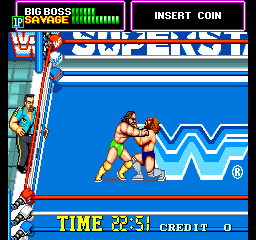
The first was WWF Superstars, which should not, under any circumstances, be confused with Acclaim's awful WWF Superstars for the Gameboy. Superstars featured eight wrestlers total, six playable ("The Million Dollar Man" Ted DiBiase and Andre the Giant are the boss team) and features only tag team play. It followed the semi-standard button mash style of gameplay popular at the time for grapplers, but the button mashes weren't nearly as hard to win against the CPU as later games like Three Count Bout.

The second is still one of the most beloved WWF games to come out, WWF Wrestlefest. Wrestlefest featured a much larger roster, much larger, more detailed sprites, and even some digitized live commentary. It was released two years later, and features twelve wrestlers, ten of which are playable (the Legion of Doom are non-playable bosses). Each wrestler has a unique set of moves, resulting in many more moves overall compared to Superstars, which had a fairly standard set for all the superstars.

In terms of play modes, it features a mode based on Saturday Night's Main Event, in which you (and a friend?) choose a tag team and try to take the Tag Team Titles from Hawk and Animal, the Legion of Doom. The other mode, which was a big deal at the time, is Royal Rumble, in which you (and up to three friends) choose superstars and have to eliminate everyone to be the last man standing. They're a little loosey-goosey with the rules of the Rumble, allowing pinfalls as well as the real Royal Rumble rule of throwing your opponent over the top rope to eliminate them.
Overall, Technos did a great job with the WWF license. Unfortunately, they only had two releases, and neither of them ever saw a console port. But I wouldn't blame you if you used MAME to play them.
The Midway Era
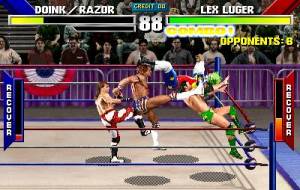
This era consists of exactly one game: WWF Wrestlemania. It was an arcade game that may as well have been called WWF Jam, since it's to WWF what NBA Jam and NFL Blitz are to basketball and football, respectively. Still, the game is a remarkable bit of fun, even if it can be beaten in about fifteen minutes on the hardest difficulty and only features eight playable wrestlers. It was ported to consoles by Acclaim, as they had both the WWF license and a deal with Midway to port their arcade games. The SNES version is gimped significantly, supporting only three characters on screen at a time and cutting Yokozuna and Bam Bam Bigelow entirely.

Following that game, Acclaim did an in house sequel, only for consoles, ironically called WWF In Your House, based on what the off-month pay-per-views (the ones that weren't Wrestlemania, King of the Ring, Summerslam, Survivor Series or the Royal Rumble) were called at the time. It added four player support, but killed everything else. The graphics were awful, the controls were sluggish and the special moves were much harder to pull off. Leave it to Acclaim to take someone else's good idea and ruin it.
The THQ Era
THQ are the current holders of the license, and they've been busy, busy, busy. The flagship series for them is the Smackdown vs. Raw series, which started simply as the Smackdown series. It began life on PS1, with two releases that were developed by Yuke's, a development house which seems to specialize in pro wrestling games. They were pretty well known in Japan for the Toukon Retsuden series, which were games based on the New Japan Pro Wrestling promotion.
Before that, they were known for their collaborations with developer AKI, who, before partnering with WWF, were responsible for WCW/nWo World Tour and WCW/nWo Revenge on the N64. AKI used the same engine for the two N64 WWF releases they did that were published by THQ. Those games were Wrestlemania 2000 and No Mercy. No Mercy is considered by fans of wrestling videogames to be among the greatest ever, if not the greatest ever. It's pacing, character creation tools, number of moves, branching storylines and myriad of unlockable content make it legendary amongst fans of the genre. If you like wrestling, No Mercy is reason enough to keep your N64. AKI went on to develop the first two Def Jam games for EA, then the Ultimate Muscle/Kinnikuman games.

On the Xbox front, THQ released two games in the Raw series, both by Anchor that were middling at best. They followed that up with Wrestlemania 21, which was mediocre by all accounts. After that, they just decided to go with the sure thing, and with the Xbox 360, they've just been releasing entries in the previously Playstation exclusive Smackdown vs. Raw series.
That series is also on the Wii now, but previously there had been a number of games on the Gamecube. They were all a bit different, with the biggest sore thumb being Wrestlemania XIX, which featured a really dumb storyline (even for a wrestling game) which basically turned the game into a Final Fight-style brawler, with you beating guys up at constructions sites and the like. It was dumb. Never play it. THQ and Yuke's did, however, finish the Gamecube era in a strong fashion with the two Day of Reckoning titles. With a similiar, but not congruent system to Smackdown vs. Raw, the Day of Reckoning titles feature a strong emphasis on story, the second game being particularly notable as it's one of the very few grapplers I can think of that starts you as the champion, then sets you on a quest to regain your title, instead of making you the wet behind the ears rookie out to prove himself and win the title.
THQ also did two GBA titles that are not great alone, but entirely un-necessary when you realize that the first two Fire Pro Wrestling releases to come to the US were on the GBA. They later experimented with other genres, including an ill-advised foray into the car combat genre with WWE Crush Hour. One odd little experiment that's surprisingly solid is WWF Betrayal, which, despite what I said about Wrestlemania XIX, is a Final Fight-style (really more Mighty Final Fight-style) brawler that works really well. You choose one of four characters (Undertaker, Stone Cold, Triple H or The Rock) and punch and kick dudes, occasionally busting our your finishing move. It's dumb and easy, but it's fun in the way the most beat-'em-ups are.

So that's my tour of WWF/WWE's videogame history. Yes, I know I didn't cover every single game, but it's just an overview. If you're really curious, check the link at the bottom of the page. Stay tuned on Wednesday for an intro to non-WWE games!
LINKS:
Wikipedia's WWE game list
The Acclaim/LJN Era
The first publisher to lay claim to WWF's games was Acclaim. Some of the games were released under the Acclaim name, some under the LJN imprint (Acclaim's way of getting around Nintendo of America's five games a year rule), nearly all were horrid. The first one released and the first one I remember playing was WWF Wrestlemania for the NES. If Wikipedia is to be believed, it was actually programmed by Rare, and if that is the case, it is Rare's worst game. Even worse than Perfect Dark Zero.

The game featured very few wrestlers, almost no grappling and a ridiculous difficulty curve. For NES gamers who had already played Pro Wrestling, it was a big step down. Unfortunately, the rest of Acclaim's NES output showed minimal improvement at best. Their 16-bit titles got a little better, culminating in Rage in the Cage, which almost no one played, as it was a Sega CD title, but it was essentially the same as the semi-highly regarded Royal Rumble for SNES & Genesis, but with FMV and more wrestlers.
In the late '90s, Acclaim went through a house cleaning and attempted to revamp their image. It kind of, sort of worked. It was around this time that we saw Turok: Dinosaur Hunter (lauded at the time, but pretty crappy in hindsight) and Acclaim's last two WWF releases, Warzone and Attitude, the former for PS1 and N64, the latter for PS1, N64 and Dreamcast.

They were very much the same game in terms of gameplay, using fighting game-esque button combos to execute wrestling moves. Attitude was the first wrestling game I remember playing that both had a robust character creation mode (Warzone feature a mode for this, but options for looks were sparse and movesets were all premade) and a story mode that semi-closely resembled actual wrestling programming. It included grudge matches and a climb from b-rate shows like Shotgun Saturday Night up to pay-per-view events like Wrestlemania. Still, as with Acclaim's other releases from the time, they've both aged pretty poorly, and are only worth checking out for nostalgia or curosity's sake.
The Ocean Era
Ocean Software made a few WWF games for gaming PCs/microcomputers in the late '80s and early '90s. The only one of these I've played is the DOS version of WWF European Rampage Tour, based on the tour of the same name. It was pretty bad, if memory serves, but the digitized Sean Mooney speech between matches was kinda neat for the time. The graphics shamed any of Acclaim's NES releases, but the gameplay was pretty well par for the course (which is to say, bad). Not much else to say, really.

The Technos Era
Now this is where WWF games get good. Technos, one of my all-time favorite developers in both the arcade and on consoles, the fine folks behind Double Dragon and River City Ransom, had the WWF license for two glorious games, one of which is still considered by some to be the best WWF game ever made.
The first was WWF Superstars, which should not, under any circumstances, be confused with Acclaim's awful WWF Superstars for the Gameboy. Superstars featured eight wrestlers total, six playable ("The Million Dollar Man" Ted DiBiase and Andre the Giant are the boss team) and features only tag team play. It followed the semi-standard button mash style of gameplay popular at the time for grapplers, but the button mashes weren't nearly as hard to win against the CPU as later games like Three Count Bout.
The second is still one of the most beloved WWF games to come out, WWF Wrestlefest. Wrestlefest featured a much larger roster, much larger, more detailed sprites, and even some digitized live commentary. It was released two years later, and features twelve wrestlers, ten of which are playable (the Legion of Doom are non-playable bosses). Each wrestler has a unique set of moves, resulting in many more moves overall compared to Superstars, which had a fairly standard set for all the superstars.
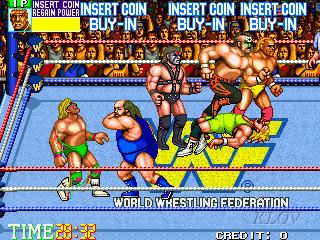
In terms of play modes, it features a mode based on Saturday Night's Main Event, in which you (and a friend?) choose a tag team and try to take the Tag Team Titles from Hawk and Animal, the Legion of Doom. The other mode, which was a big deal at the time, is Royal Rumble, in which you (and up to three friends) choose superstars and have to eliminate everyone to be the last man standing. They're a little loosey-goosey with the rules of the Rumble, allowing pinfalls as well as the real Royal Rumble rule of throwing your opponent over the top rope to eliminate them.
Overall, Technos did a great job with the WWF license. Unfortunately, they only had two releases, and neither of them ever saw a console port. But I wouldn't blame you if you used MAME to play them.
The Midway Era
This era consists of exactly one game: WWF Wrestlemania. It was an arcade game that may as well have been called WWF Jam, since it's to WWF what NBA Jam and NFL Blitz are to basketball and football, respectively. Still, the game is a remarkable bit of fun, even if it can be beaten in about fifteen minutes on the hardest difficulty and only features eight playable wrestlers. It was ported to consoles by Acclaim, as they had both the WWF license and a deal with Midway to port their arcade games. The SNES version is gimped significantly, supporting only three characters on screen at a time and cutting Yokozuna and Bam Bam Bigelow entirely.
Following that game, Acclaim did an in house sequel, only for consoles, ironically called WWF In Your House, based on what the off-month pay-per-views (the ones that weren't Wrestlemania, King of the Ring, Summerslam, Survivor Series or the Royal Rumble) were called at the time. It added four player support, but killed everything else. The graphics were awful, the controls were sluggish and the special moves were much harder to pull off. Leave it to Acclaim to take someone else's good idea and ruin it.
The THQ Era
THQ are the current holders of the license, and they've been busy, busy, busy. The flagship series for them is the Smackdown vs. Raw series, which started simply as the Smackdown series. It began life on PS1, with two releases that were developed by Yuke's, a development house which seems to specialize in pro wrestling games. They were pretty well known in Japan for the Toukon Retsuden series, which were games based on the New Japan Pro Wrestling promotion.
Before that, they were known for their collaborations with developer AKI, who, before partnering with WWF, were responsible for WCW/nWo World Tour and WCW/nWo Revenge on the N64. AKI used the same engine for the two N64 WWF releases they did that were published by THQ. Those games were Wrestlemania 2000 and No Mercy. No Mercy is considered by fans of wrestling videogames to be among the greatest ever, if not the greatest ever. It's pacing, character creation tools, number of moves, branching storylines and myriad of unlockable content make it legendary amongst fans of the genre. If you like wrestling, No Mercy is reason enough to keep your N64. AKI went on to develop the first two Def Jam games for EA, then the Ultimate Muscle/Kinnikuman games.

On the Xbox front, THQ released two games in the Raw series, both by Anchor that were middling at best. They followed that up with Wrestlemania 21, which was mediocre by all accounts. After that, they just decided to go with the sure thing, and with the Xbox 360, they've just been releasing entries in the previously Playstation exclusive Smackdown vs. Raw series.
That series is also on the Wii now, but previously there had been a number of games on the Gamecube. They were all a bit different, with the biggest sore thumb being Wrestlemania XIX, which featured a really dumb storyline (even for a wrestling game) which basically turned the game into a Final Fight-style brawler, with you beating guys up at constructions sites and the like. It was dumb. Never play it. THQ and Yuke's did, however, finish the Gamecube era in a strong fashion with the two Day of Reckoning titles. With a similiar, but not congruent system to Smackdown vs. Raw, the Day of Reckoning titles feature a strong emphasis on story, the second game being particularly notable as it's one of the very few grapplers I can think of that starts you as the champion, then sets you on a quest to regain your title, instead of making you the wet behind the ears rookie out to prove himself and win the title.
THQ also did two GBA titles that are not great alone, but entirely un-necessary when you realize that the first two Fire Pro Wrestling releases to come to the US were on the GBA. They later experimented with other genres, including an ill-advised foray into the car combat genre with WWE Crush Hour. One odd little experiment that's surprisingly solid is WWF Betrayal, which, despite what I said about Wrestlemania XIX, is a Final Fight-style (really more Mighty Final Fight-style) brawler that works really well. You choose one of four characters (Undertaker, Stone Cold, Triple H or The Rock) and punch and kick dudes, occasionally busting our your finishing move. It's dumb and easy, but it's fun in the way the most beat-'em-ups are.

So that's my tour of WWF/WWE's videogame history. Yes, I know I didn't cover every single game, but it's just an overview. If you're really curious, check the link at the bottom of the page. Stay tuned on Wednesday for an intro to non-WWE games!
LINKS:
Wikipedia's WWE game list
Sunday, January 11, 2009
Visual Storytelling in Wrestling
I hate the JBL/HBK storyline that's going on on Raw right now, but probably not for the reasons you might think. Yes, I'll concede that it's stupid for us, as viewers, to be expected to believe that Shawn Michaels is so broke that his multi-million dollar salary can't sustain him and his family. Yes, it's stupid for us to be expected to believe that JBL is that rich that he can afford to pay Shawn so much more than his already multi-million dollar salary as to make it worth it to him to compromise his principles.
But that's not why I hate the angle.
I hate the angle because aside from two in ring occurences (HBK slaps JBL, thereby getting Rey Mysterio DQ'd from his Fatal Fourway qualifying match, and HBK takes the Clothesline from Hell without defending himself, allowing JBL to win the aforementioned Fatal Fourway), the entire story has been furthered by talking. JBL talks to the crowd, Todd Grisham talks to HBK, HBK talks to the crowd, HHH talks to HBK, Jericho & Orton talk to JBL, JBL talks to HBK, HBK talks to Cena... STOP TALKING!
Much like in my "Visual Storytelling in Videogames" essay, I want to clarify that I do not hate promos and backstage vignettes. Promos have a function, and have since pro-wrestling began, even moreso since pro-wrestling began on TV (which is not long after anything began on TV), but until the late '90s, they were used much more sparingly. The late '90s were the heyday of the promo, featuring editions of both Raw and Nitro that did not have so much as an arm drag until 45 minutes in. Thankfully, those days are over, but there's still some holdover.
Holdover like the HBK/JBL storyline. Now, HBK and JBL are two of the best "stick men" (i.e. guys who cut good promos) in wrestling today. In fact, I would argue that JBL's at his very best when he's cutting a promo, and he could make a great manager when he decides to leave the ring for good, but that doesn't change the fact that having a storyline play out almost exclusively in the realm of the promo is just lazy storytelling.
It was even revealed that HBK was in JBL's employ in a promo. Can you think of a bigger waste? He could've screwed Rey by slapping JBL before anyone knew he was working for him, then explained in a brief promo that he did it to save JBL's title chances because "blah, blah, blah, I'm a broke millionaire."
He could've saved JBL from a beatdown. He could've done something as simple as putting JBL's foot on the rope when he was being pinned during a match, any match, really. What did WWE's brilliant writing staff come up with instead? "Shawn Michaels works for me now."
Wow. That's some riveting television, that is. Nothing like a goof in a cowboy hat telling me he hired another goof in a cowboy hat. Puts me right on the edge of my seat, that does. How come these guys didn't win any Golden Globes tonight?
On the flip side, let's look at the Jake "The Snake" Roberts/"Ravishing" Rick Rude feud of 1988. It starts with a promo, but one with a good hook. Rude hits on a pretty girl, she turns out to be Mrs. "The Snake." Simple, short, to the point, right? Right. Roberts runs out, punches Rude (Action! How novel of a concept!), a bunch of "enhancement talent" runs out and pulls them apart.
Following that incident, Rude gets some tights with Mrs. Snake's face on them, Roberts warns in a very brief promo that he shouldn't do it again, Rude does, Roberts comes to the ring and pulls them off in front of a live audience following a match. The two have a match at Saturday Night's Main Event in October, Roberts wins, starts a feud with Andre the Giant.
Now, of course, that's a simplification of the events of that feud, but a simplification of this one would read "JBL and HBK talk about HBK working for JBL. HBK slaps JBL, then takes a dive to him in a Fatal Fourway for a title match at the Royal Rumble."
The point is that visual storytelling is not the difficult, especially in a media that are so given to it in the first place. Aural storytelling is not effective in wrestling, it never has been, and it never will be. The crowds are too big and putting lapel mics on the wrestlers would be impossible unless they all dressed like Rick Martel (yes, he is a model).
Wrestling is pure visual storytelling. A great match will always be a great match, regardless of context, because the two (or four or six or sometimes ten) guys in the ring will tell it. A great promo, though? Well, no matter how great it is, without context, you won't know what the guy is talking about, even if he sounds good doing it.
Subscribe to:
Posts (Atom)

 Posts